
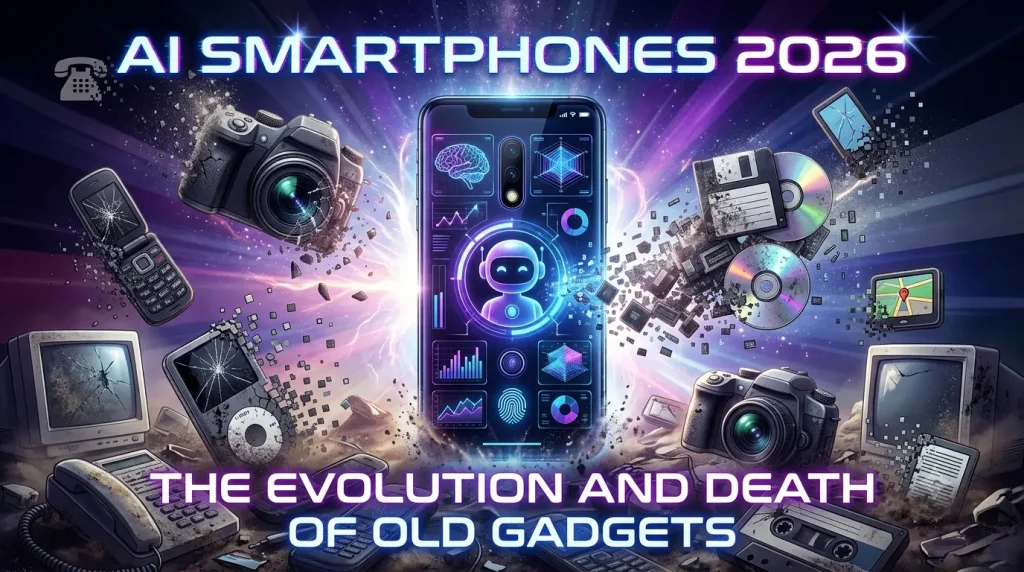
AI smartphones 2026 have officially rewritten the rules of the global technology market, signaling a massive shift in how we interact with personal computing. For decades, the tech industry operated under a predictable rule of fragmentation. If you wanted to capture professional-grade photographs, you bought a DSLR camera. If you needed to record cinematic travel vlogs, you packed a dedicated camcorder. For heavy office productivity, you opened a laptop. For gaming, you booted up a console.
As on-device generative tools become mainstream, the line between reality and synthetic media is blurring. While exploring these upgrades, it is crucial to understand the dark side of AI content and how deepfakes or automated manipulation are impacting digital trust.
Each gadget was a king of its own specific domain.
But as we cross the mid-way point of this year, that rule has been completely liquidated. The smartphone is no longer just a communication tool or a convenient pocket companion; it has officially absorbed the traditional gadget landscape. The catalyst behind this aggressive phase of consolidation isn’t thinner glass, larger batteries, or faster megahertz. The true kingmaker is local, on-device Artificial Intelligence. If you are wondering if it’s still worth investing in dedicated gear, check out our guide on how to write a DSLR camera article for your tech blog to understand the market shift.
Through the integration of custom-built Neural Processing Units (NPUs), hyper-optimized small language models (SLMs), and sophisticated machine learning architectures, these modern devices have transcended traditional computing constraints. They do not just process commands—they predict, adapt, generate, and execute complex workflows locally. This is the definitive story of how mobile technology evolved, how AI claimed the throne, and why the modern smartphone has become the undisputed king of all gadgets. The true kingmaker is local, on-device Artificial Intelligence, which is why AI smartphones 2026 are taking over the tech world.
The Historic Shift: How AI Smartphones 2026 Redefined Intelligent Companions
To appreciate where we are in 2026, we must look at how the fundamental definition of a smartphone has changed. For over a decade, a phone was deemed “smart” simply because it could connect to the internet, run applications, and pull data from remote servers.
The Eras of Mobile Evolution
To map this trajectory, we can divide mobile history into four distinct eras:
Standalone casual imaging hardware.
On-device NPUs instantly calculate physics-based lighting and lens optics digitally.
Single-purpose audio capture tools.
Local AI summarizes, formats, separates speakers, and translates speech instantly.
Low-end productivity machines.
AI agents execute multi-step workflows across apps via external monitor docks.
In the Cloud Era, if you asked your phone’s voice assistant a question, your voice sample traveled to an external server miles away, parsed the request, and bounced back an answer. This created latency, required a constant high-speed data connection, and opened vast data privacy vulnerabilities.
In 2026, AI smartphones do the heavy lifting right in your pocket. The paradigm has shifted from reactive machines to proactive computing partners. Today’s device understands what is on your screen, remembers your contextual habits, manages its own performance profiles dynamically, and interprets messy, natural human language with absolute precision.
1. Under the Hood: The Silicon Powering AI Smartphones 2026
The massive leap in smartphone capability is directly tied to a massive revolution in silicon manufacturing. The central processing unit (CPU) and graphics processing unit (GPU) are no longer the exclusive stars of mobile chipsets. Instead, the spotlight belongs entirely to the Neural Processing Unit (NPU). Instead, the spotlight belongs entirely to the Neural Processing Unit (NPU) engineered specifically for AI smartphones 2026. For a deep dive into how mobile silicon architecture has shifted toward matrix multiplication chips, you can read the latest architectural breakdowns on Tom’s Hardware.
+-----------------------------------------------------------+
|               Modern 2026 Mobile Chipset                   |
|                                                           |
|   +-------------------+           +-------------------+   |
|   |     CPU Core      |           |     GPU Core      |   |
|   |  (General Tasks)  |           | (Graphic Render)  |   |
|   +-------------------+           +-------------------+   |
|                                                           |
|   +---------------------------------------------------+   |
|   |            Neural Processing Unit (NPU)           |   |
|   |    * Local LLM Execution   * Live Text Embedding  |   |
|   |    * Real-Time ISP Assist  * Predictive Battery   |   |
|   +---------------------------------------------------+   |
+-----------------------------------------------------------+
The NPU and Local Compute Dominance
Modern mobile chipsets are engineered from the ground up to handle massive matrix multiplications—the foundational mathematical operations behind neural networks.
By designing dedicated silicon exclusively for AI tasks, 2026 chipsets process billions of operations per second (TOPS) at a fraction of the energy cost. Tasks that would typically drain a battery in an hour or overheat a phone chassis are now handled seamlessly in the background.
Why Local Compute Matters for AI Smartphones 2026
- Zero Latency: Because the computational models reside locally on the device’s storage and execute within the NPU, there is no round-trip wait time to an external server. Live audio translation or real-time video manipulation happens instantly.
- Radical Privacy: Your personal documents, raw voice patterns, and private photographs never leave your device. The training, fine-tuning, and inference happen within a secure enclave on the hardware level.
- Offline Independence: Whether you are deep inside a remote mountain valley without cellular reception or cruising at 35,000 feet on an airplane, the core generative capabilities of your smartphone remain fully operational.
- Future-Proof Infrastructure: As software models grow more complex, the hardware inside AI smartphones 2026 ensures that devices don’t slow down over time, maintaining blazing-fast local processing speeds.
2. Liquidating the Camera Market: Computational and Generative Photography
Perhaps no industry has felt the crushing weight of the smartphone’s evolution quite like traditional photography. For years, professional photographers dismissed phone cameras due to physical limitations: tiny image sensors, cramped lens optics, and a lack of true physical depth of field.
AI bypassed those physics limitations entirely through computational and generative photography. By utilizing deep learning algorithms, AI smartphones 2026 can instantly reconstruct images, calculate accurate depth fields, and out-perform mid-range standalone lenses. To see how these algorithmic leaps match up against traditional glass optics, check out the comprehensive mobile camera testing data on DxOMark.
AI bypassed those physics limitations entirely through computational and generative photography.
Beyond the Lens: Real-Time Cognitive ISPs
When a user presses the shutter button on a 2026 flagship phone, the device does not simply capture a single frame of light. The Image Signal Processor (ISP), closely linked with the NPU, performs an instantaneous, layer-by-layer analysis of the scene.
It identifies semantic layers: it isolates human skin textures, separates foreground hair strands, detects sky gradients, and recognizes fabric weaves. Each layer is processed with individual exposure, noise reduction, and sharpening matrices.
[ Light Input ] ---> [ Physical Lens Group ] ---> [ Image Sensor Matrix ]
                                                          |
                                                          v
                                              [ Multi-Layer Semantic NPU ]
                                              |-- Layer 1: Skin Tones
                                              |-- Layer 2: Sky Gradients
                                              |-- Layer 3: Fabric Textures
                                                          |
                                                          v
                                              [ Final Optimized Output ]
The Rise of Generative Video and Fluid Frame Creation
The real breakthrough of 2026 is real-time AI video enhancement. High-end smartphones can now upsample 4K video frames on the fly, applying temporal noise reduction in low-light environments that rivals cinema gear.
Furthermore, generative AI can seamlessly reconstruct missing details in frames where motion blur occurs, ensuring that fast-moving action shots remain flawlessly crisp.
The Virtual Lighting Studio
The inclusion of deep generative models allows users to completely manipulate the lighting environment after a photo is taken. Want to change a harsh midday afternoon shot into a soft, golden-hour portrait? The local AI maps a 3D mesh of the subject’s face and synthetically recalculates how light shadows should fall across their features, rendering traditional bulky reflectors and studio strobes obsolete. This studio-grade manipulation is a standard benchmark for AI smartphones 2026.
For digital content creators and tech platforms like phadera.com, content creation workflows have contracted dramatically. If you are leveraging these new mobile tools for video production, see our breakdown on creating high-engagement video scripts using AI tools.
3. The Death of the App Store: The Era of the AI Agent
Since the launch of early mobile ecosystems, our interaction with smartphones has been explicitly app-centric. If you wanted to book a flight, check your budget, text a friend, and edit a document, you had to jump between four separate applications, copying and pasting data across different user interfaces.
AI smartphones in 2026 are actively killing this classic workflow via Unified AI Agents. Instead of behaving as a collection of isolated digital silos, the core operating system of AI smartphones 2026 operates as a singular, cohesive engine that prioritizes user intent.
AI smartphones in 2026 are actively killing this workflow via Unified AI Agents.
Natural Language as the System OS
Instead of behaving as a collection of isolated digital silos, the modern smartphone OS operates as a singular, cohesive engine. The user interacts primarily via fluid natural language commands or contextual gestures.
Example Workflow: “Look up my flight confirmation in my emails, check if my hotel booking matches those dates, text Sarah that I’ll be arriving two hours late due to the schedule shift, and draft an automatic out-of-office calendar reply for work.“
In the past, this required tedious manual multitasking. In 2026, the device-wide AI agent interprets the request, securely queries your local mail database, hooks into your calendar API, interacts with your messaging infrastructure, and completes the entire cross-app sequence autonomously within seconds.
                       [ User Input: Natural Voice Command ]
                                        |
                                        v
                       [ Central System AI Agent (OS Core) ]
                                        |
       +--------------------------------+--------------------------------+
       |                                |                                |
       v                                v                                v
[ Emails Database ]            [ Calendar Engine ]            [ Messaging Framework ]
  Extract Flight                  Cross-Reference                  Draft & Send Update
This structural evolution repositions apps into silent, background data providers. The user interface becomes completely dynamic, rendering only the necessary text, maps, or buttons you need at that exact fraction of a second.
4. Redefining Productivity and Creativity on the Go
The concept of a mobile workstation used to mean struggling to view an excel sheet on a cramped screen or correcting typos on a virtual keyboard. Today, AI has turned the smartphone into an elite creative and professional powerhouse.
Real-Time, Two-Way Audio Translation
For global business, travel, and cross-border collaboration, language barriers have crumbled. AI smartphones process local, real-time audio translation during live cellular calls or face-to-face conversations.
As a speaker talks in Nepali, Spanish, or Japanese, the recipient hears the translated audio rendered in their native language almost instantly, complete with natural voice inflection matched to the speaker’s original vocal profile.
Pocket-Sized Creative Directors
For digital content creators and tech platforms like phadera.com, content creation workflows have contracted dramatically. The processing blocks native to AI smartphones 2026 leverage local generation engines to create high-definition assets, edit background noise, and draft copy in seconds. Mobile text-to-image and text-to-video engines leverage local processing blocks to generate high-definition layout assets, edit audio files to remove background hiss with extreme acoustic accuracy, and suggest stylistic edits for text copy instantly.
The phone is no longer just a consumption device; it is a full-fledged production studio capable of managing complex asset pipelines locally.
5. Overcoming Hardware Limits: Thermal Management and Optimization
Running billion-parameter neural networks continuously inside a device that sits in a user’s denim pocket introduces immense engineering difficulties. Silicon processing generates heat, and excessive heat leads to aggressive thermal throttling and accelerated battery degradation.
Mobile manufacturers in 2026 have cracked this problem through a combination of cutting-edge hardware thermal systems and hyper-intelligent background software controls.
Advanced Vapor Cooling Mechanics
To keep advanced NPUs operating at peak clock speeds during extended AI inference sessions, modern smartphones deploy sophisticated Vapor Cooling (VC) systems. These ultra-thin copper or stainless-steel chambers contain a tiny amount of liquid that vaporizes as the processor heats up.
The vapor naturally migrates to cooler areas of the device, condenses back into liquid, and flows back via a capillary wick structure. This continuous thermodynamic loop spreads thermal energy uniformly across the entire surface area of the phone, ensuring the device remains cool to the touch even when rendering complex AI tasks. For an inside look at how these physical thermal layers are built into modern hardware chasses, see the teardown analyses on Android Authority.
       +-------------------------------------------------------+
       |                  Vapor Cooling Cycle                  |
       |                                                       |
       |    [ Hot Processor Area ] ----> Evaporates Liquid      |
       |              ^                        |               |
       |              |                        v               |
       |         Liquid Returns <---- Condenses at Cool End    |
       |         via Capillary Wick                            |
       +-------------------------------------------------------+
Predictive Battery Management Systems
Standard battery management systems historically relied on rigid, pre-defined rules. However, the battery protocols built into AI smartphones 2026 implement continuous predictive tracking to map out your exact daily power needs.
2026 AI smartphones implement continuous predictive battery tracking. By learning your daily routines down to the minute, the system maps out exactly when you need peak computing power and when your phone sits idle.
- It dynamically adjusts individual core voltages.
- It scales down NPU precision cycles when deep reasoning isn’t required.
- It optimizes charging curves to protect battery chemistry, extending the overall lifecycle of the lithium matrix.
6. The Broader Impact: Which Gadgets Are Now Obsolete?
As the smartphone’s capabilities expand exponentially under the influence of AI, it continues to devour nearby device ecosystems. Let’s look at the hardware categories that have been entirely absorbed or pushed to the absolute fringes of the consumer market:
Standalone Point-and-Shoot & Mid-Range Cameras
With cognitive ISPs delivering flawless edge-detection portraits and generative models filling in physical optic deficiencies, the market for casual, mid-range cameras has collapsed entirely. Outside of high-end commercial cinema or specialized studio setups, your phone is the only lens you need. We analyzed this exact performance jump in our deep dive into the iPhone 17 Pro Max vapor cooling performance.
Traditional Audio Recorders and Transcription Gear
Journalists, researchers, and students no longer carry dedicated voice recorders. An AI smartphone tracks conversations, automatically identifies separate speakers based on acoustic signatures, creates an instant, punctuated transcript, and summarizes the meeting notes into bullet points in real time.
Entry-Level Laptops and Tablets
For a vast demographic of users whose daily digital tasks consist of writing reports and managing communication pipelines, the powerful processing units inside AI smartphones 2026 provide all the necessary computing power required, removing the need for travel laptops. You can see this computing power in action in our recent Realme GT 8 Pro flagship review.
7. The Roadmap Ahead: What Lies Beyond 2026?
The convergence of artificial intelligence and mobile hardware is far from finished. As we peer past 2026, the blueprints for upcoming mobile iterations show even deeper physical-digital integration.
Evolution Toward Seamless Ambient Interfaces
The long-term goal of the tech industry is to make the physical piece of slab glass in your hand gradually disappear into the background. Future iterations point toward phones acting as the localized processing brains for lightweight, stylish augmented reality (AR) smart glasses. For ongoing coverage on how mobile ecosystems are merging with next-gen smart eyewear, follow the spatial computing hub on The Verge.
The AI on your phone will interpret your surrounding world through those glasses, overlaying navigation markers, contextual reminders, and real-time data onto your physical environment seamlessly.
Biological and Intent-Based Interfaces
Early development is already underway for more intuitive human-computer interfaces. Advanced multi-modal systems will soon track subtle eye movements, micro-gestures, and predictive context to understand exactly what information you require before you even speak an explicit command aloud.
The smartphone will shift from a device you consciously open and interact with, into an ambient, supportive layer woven directly into your daily life.
Conclusion: The Absolute Sovereignty of the Mobile Form Factor
The evolution of mobile technology stands as a masterclass in relentless innovation. The smartphone did not claim the tech throne by simply matching the physical specifications of separate gadgets; it won by completely changing the paradigm. Looking back, AI smartphones 2026 will be remembered as the turning point where mobile devices became truly cognitive companions.
By merging custom NPU architectures, advanced vapor cooling networks, on-device AI agent operating systems, and stunning computational photography pipelines, the modern phone has rendered massive walls of electronic gear completely obsolete.
As we look at the tech landscape of 2026, the verdict is absolute. The fragmentation of our digital tools is officially over. The smartphone has completely devoured the competition, standing alone as the ultimate, undisputed king of gadgets.
Key Takeaways for Tech Enthusiasts
- Local Processing Over Cloud: On-device AI ensures that your smartphone remains fast, private, and independent of internet access.
- Hardware Adaptation: Advanced internal cooling techniques like vapor cooling are vital elements that allow modern silicon chips to run intense AI tasks without dropping performance.
- The Unified Future: Apps are slowly fading into background infrastructure, clearing a direct path for smart AI agents to control our daily device interactions through natural language.
Frequently Asked Questions
What gadgets are being replaced by AI smartphones in 2026?
AI smartphones are rapidly making several standalone devices obsolete, most notably entry-level DSLR cameras, dedicated voice recorders, handheld GPS units, e-readers, and physical media drives. By integrating advanced on-device agentic AI, modern phones handle heavy computing, imaging, and automation natively, eliminating the need for single-purpose consumer electronics.
Are AI smartphones making DSLR cameras obsolete?
Yes, for the vast majority of consumer and casual photographers, AI smartphones are replacing DSLR cameras. Thanks to 2026 generative photography engines, computational physics, and instant AI semantic editing, smartphones can mimic complex lens optics and lighting perfectly, removing the necessity of carrying heavy hardware.
What features make a smartphone an “AI phone” in 2026?
A true 2026 AI smartphone is defined by dedicated hardware neural processing units (NPUs) capable of running large language models locally on-device. Key features include proactive agentic AI assistants that manage apps for you, real-time multimodal translation, predictive battery management, and instant generative photo and video synthesis without cloud rendering.
Will AI phones completely eliminate the need for laptops?
While AI smartphones have taken over basic productivity, media editing, and everyday tasks, they will not completely eliminate laptops. Professionals requiring heavy desktop computing power, multi-screen multitasking, complex programming environments, and massive local storage will still rely on traditional computers, though the gap is closing rapidly.
How do on-device AI assistants differ from old voice assistants?
Unlike older voice assistants that relied on rigid, cloud-based voice commands to perform basic internet searches, 2026 on-device agentic AI operates locally, features contextual memory, handles complex multi-step reasoning, and can autonomously take actions across different apps without requiring manual user intervention.

Dal Bahadur is a passionate tech enthusiast, hardware reviewer, and the founder of Phadera Tech. With years of experience in mobile technology and digital troubleshooting, he specializes in deep-dive smartphone reviews, gadget guides, and practical tech tips. His goal is to help readers make informed decisions before buying their next gadget.