
An In-Depth Look at the Next Generation Professional Smartphone
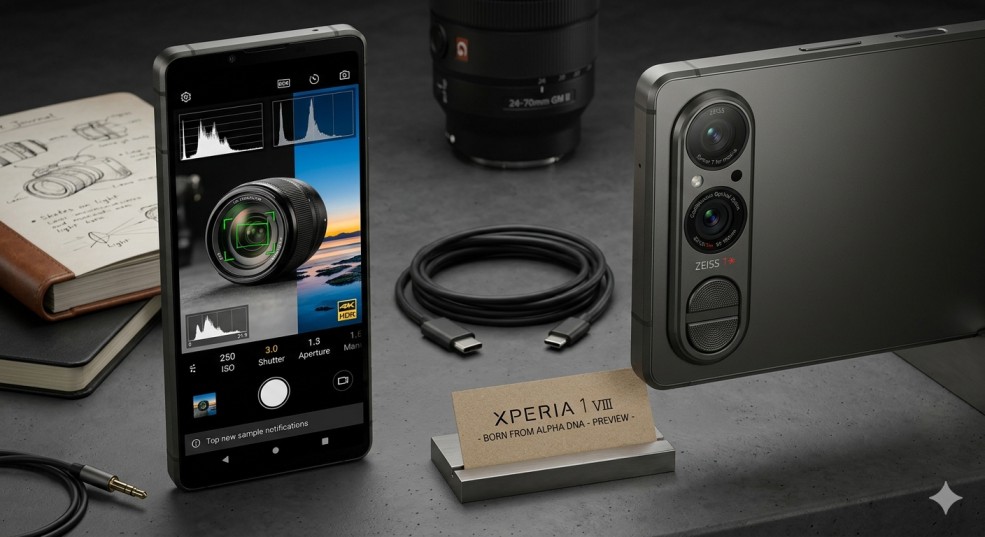
For years, Sony has carved a unique niche in the smartphone industry. While other manufacturers chase mass-market trends like foldable screens or aggressive AI beauty filters, Sony has remained steadfast in its commitment to professional-grade hardware and manual creative control. As we look toward the expected release of the Sony Xperia 1 VIII, the anticipation isn’t just about a new phone—it’s about the convergence of Sony’s world-leading Alpha camera technology and mobile computing.
As enthusiasts await the official launch, the Sony Xperia 1 VIII is expected to bridge the gap between professional cinematography and mobile portability.
Before diving deep into the future of the VIII series, it is essential to understand how Sony perfected the current generation. To see how the current hardware performs in real-world professional scenarios, you can read our comprehensive analysis here:
Table of Contents
1. The Sony Xperia 1 VIII Design Philosophy: Functional Elegance
Sony is expected to maintain its signature 21:9 aspect ratio. This tall, slender form factor isn’t just for aesthetics; it is designed for cinematic consumption and a superior grip.
- Build Materials: We expect a transition to a Grade 5 Titanium frame, similar to the trend in ultra-premium flagships, reducing weight while increasing structural integrity.
- The Bezel Debate: Unlike competitors who use punch-holes, Sony will likely stick to slim top and bottom bezels to house the front camera and dual front-firing stereo speakers. This ensures an uninterrupted 4K viewing experience.
- Sustainability: Expect 100% plastic-free packaging and increased use of SORPLAS™ (Sony’s recycled plastic) in internal components.
2. Display: The 4K HDR Mastery
The Xperia 1 series is the only smartphone line consistently offering a 4K resolution. For the VIII, the focus won’t just be on pixels, but on luminance and accuracy. When it comes to visual fidelity, the Sony Xperia 1 VIII will likely continue Sony’s legacy as the only brand offering a native 4K experience.
- Peak Brightness: A jump to 2500–2800 nits is expected to combat direct sunlight, a previous pain point for Xperia users.
- BRAVIA Integration: Using the latest “X-Reality for mobile” engine, the device will likely mirror the color science of Sony’s 2026 BRAVIA TV lineup, offering 10-bit equivalent tonal gradation.
The reason the tech world is so excited about the upcoming Xperia 1 VIII is that Sony has never compromised on build quality or professional utility. While other brands follow fleeting design trends, Sony focuses on providing a professional-level interface that mirrors their $5,000 Alpha cameras.
As we noted in our viral analysis of the brand’s philosophy:
No One Can Beat Sony in the Smartphone Game – Unmatched Quality and a Pro-Level Interface
3. Why the Sony Xperia 1 VIII Camera is the 2026 Hardware King
This is where the Xperia 1 VIII is expected to dominate. Sony doesn’t just buy sensors; they build them.
Exmor T for Mobile (Generation 2)
The “Stacked” CMOS sensor technology introduced in previous models will likely see its second iteration. By separating the photodiode and the transistor layers, the VIII will capture significantly more light with less noise, rivaling 1-inch sensors found in dedicated point-and-shoot cameras.
If you’re curious about how Sony’s current engineering philosophy stacks up against futuristic concepts, check out our detailed showdown:
Tesla Pi vs. Sony Xperia 1 VII (2026): Which Phone Actually Feels Like a True Flagship?
True Optical Zoom
While others use “periscope” lenses with fixed focal points and digital cropping, Sony is expected to refine its Continuous Optical Zoom. We anticipate a range of 85mm to 175mm, allowing for seamless zooming without any loss in image quality.
Hardware Shutter Button
The dedicated two-stage shutter button—a staple of the line—will remain, likely featuring a more tactile, textured finish for better “half-press” focus control.
4. Detailed Specs Comparison: Sony Xperia 1 VII vs. Sony Xperia 1 VIII
📸 SONY XPERIA: GEN 7 vs GEN 8
5. Software: The “Pro” Suite
The software on the Xperia 1 VIII isn’t meant to hold your hand; it’s meant to give you the keys to the kingdom.
- Photography Pro: Expect a UI that is indistinguishable from the Sony Alpha A7R V menu system.
- Video Creator & External Monitor App: With the rise of vlogging, the VIII will likely double as a high-end 4K external monitor for Sony Alpha cameras via USB-C, featuring built-in recording and streaming capabilities.
- Audio Excellence: Sony will continue to support 360 Reality Audio, Hi-Res Audio (Wired & Wireless), and LDAC. The 3.5mm jack remains a “pro” requirement for zero-latency monitoring.
If you are curious about the technical feasibility and the latest market trends surrounding this, you should check out this detailed breakdown:
Read the full story here: Canon Smartphone 2026 Analysis
Whether it’s a dedicated “Vlog-phone” or a high-end flagship collaboration, the prospect of a Canon-branded lens on a smartphone is definitely something to keep an eye on this year!
6. Performance and Gaming
Driven by the Snapdragon 8 Gen 5, the Xperia 1 VIII will be a gaming powerhouse. Sony’s “Game Enhancer” software allows for H.S. Power Control (Heat Suppression), where the charger powers the phone directly without charging the battery, preventing overheating during intense gaming or long 4K filming sessions. Powering the Sony Xperia 1 VIII is the rumored Snapdragon 8 Gen 5, ensuring that the pro-level apps run without a glitch.
7. The Verdict: Who is this for?
The Sony Xperia 1 VIII will not be a “mass-market” phone. It is expected to be a niche, high-priced tool.
- For Photographers: It is the best companion for an Alpha setup.
- For Audiophiles: It remains the only flagship respecting the wired connection.
- For Cinephiles: The 21:9 4K screen provides the most accurate movie-watching experience on the move.
Sony’s “King of Hardware” title is safe because they focus on tangible specs—better glass, better sensors, and better cooling—rather than flashy software gimmicks.
Final Thoughts for the Reader
When the Xperia 1 VIII eventually hits the shelves, don’t expect a radical redesign. Expect a refined instrument. Sony is building a legacy of consistency. If you value manual control and industrial precision over automated “AI-everything,” the Xperia 1 VIII will likely be the most capable slab of hardware in your pocket.
Final thoughts on the Sony Xperia 1 VIII: It isn’t just a phone; it’s a precision instrument for those who refuse to compromise.
What is your priority in a pro-level smartphone? Is it the raw sensor power or the software simplicity?
The Sony Xperia 1 VIII remains a powerhouse for creators, but it’s interesting to see it alongside other upcoming giants. You can also explore how it stacks up against the leaked Galaxy Z Fold 8 design to see which flagship approach suits your lifestyle better.
Frequently Asked Questions (FAQ)
Does the Sony Xperia 1 VIII still have a 3.5mm Headphone Jack?
Yes. Based on Sony’s commitment to “Pro” users and audiophiles, it is highly expected that the Xperia 1 VIII will retain the 3.5mm headphone jack. This allows for zero-latency audio monitoring while recording video and high-fidelity listening without the need for dongles.
Is the 4K display “Always On” in 4K resolution?
To preserve battery life, Sony typically uses an adaptive resolution. While the hardware is 4K, the software usually renders the UI in 1080p or 2K and switches to Full 4K automatically when you view high-resolution photos, 4K videos on YouTube, or use the Cinema Pro app.
How does the “Continuous Optical Zoom” differ from other phones?
Most smartphones use multiple fixed lenses (e.g., 3x and 10x) and use digital cropping to fill the gap between them. The Xperia 1 VIII is expected to use a moving lens mechanism (like a DSLR lens), meaning every focal point between 85mm and 190mm is true optical quality with no digital degradation.
Will the Xperia 1 VIII get better software support?
Sony has historically been slower with updates compared to Samsung or Google. However, for the VIII series, it is expected that Sony will move toward a 4-year OS update and 5-year security patch cycle to match modern industry standards for premium flagships.
Can I use the Xperia 1 VIII as a monitor for my Sony Alpha Camera?
Yes. One of the standout “ecosystem” features is the ability to connect the phone to a Sony Alpha camera via a USB-C to Micro-HDMI/USB-C cable. The phone then acts as a high-brightness 4K external monitor with touch-focus capabilities and the ability to stream camera footage directly to YouTube or Twitch using 5G.
Does the phone support fast charging?
While Sony focuses on Battery Care (slower charging to ensure the battery lasts for 3+ years without degrading), the Xperia 1 VIII is expected to support up to 45W PD charging, which is a slight increase from previous generations, along with Qi2 magnetic wireless charging.
Why is there no “Punch-hole” or “Notch” on the screen?
Sony believes in an uninterrupted viewing experience. By keeping very slim bezels at the top and bottom, they can house a high-quality front camera, front-firing speakers, and a notification LED without cutting a hole into your content.
Is the camera easy to use for a beginner?
The Xperia 1 VIII features a “Basic Mode” for point-and-shoot photography. However, the phone is truly designed for those who understand ISO, Shutter Speed, and White Balance. If you are a beginner, the “Photography Pro” app is a great way to learn manual photography.
How does the “Heat Suppression” (H.S. Power Control) work?
This is a favorite feature for gamers and vloggers. When plugged in, the phone can pull power directly from the cable to run the processor, bypassing the battery entirely. This prevents the battery from heating up, which is the main cause of thermal throttling and hardware lag.
Will it support a microSD card?
Yes. Sony remains one of the few manufacturers to offer a tool-less microSD card slot (up to 1TB or 2TB). This is essential for creators who record large 4K 120fps video files and need to swap storage quickly.
Is the Sony Xperia 1 a good phone?
Yes, the Sony Xperia 1 series (especially the latest Xperia 1 VIII) is an excellent phone, but it is a “niche” device. It is specifically designed for professional photographers, filmmakers, and audiophiles. While most flagships focus on AI-driven “point-and-shoot” photos, the Xperia 1 offers full manual controls (Alpha DNA), a 4K OLED 21:9 display, and a 3.5mm headphone jack. If you want a phone that feels like a professional tool, it’s one of the best; however, for a casual user, the learning curve might be steep.
Is Sony camera better than iPhone?
It depends on the user. The iPhone is generally better for “computational photography”—meaning it uses AI to make photos look social-media-ready instantly. However, Sony’s camera hardware is technically superior for professionals. Sony uses larger sensors and Zeiss optics that provide a more “natural” and realistic look. If you know how to use manual settings (ISO, Shutter Speed, White Balance), a Sony Xperia can produce higher-quality, cinema-grade results that an iPhone cannot replicate.
Which Sony Xperia phone is the best?
As of April 2026, the Sony Xperia 1 VIII is the best flagship phone in the lineup, offering the most advanced Alpha camera technology and the latest Snapdragon processor. For those who want a more compact flagship, the Xperia 5 series remains a top choice, while the Xperia 10 VIII is the best option for budget-conscious users looking for great battery life and a premium 21:9 display experience.
Is Sony stopping Xperia?
No, Sony is not stopping the Xperia line. In early 2026, Sony’s leadership (CFO Lin Tao) officially confirmed a “no change in status” for the Xperia brand. While Sony has partnered with other companies for its TV manufacturing, it has kept full control over Xperia development and manufacturing. Recent listings in the GSMA IMEI database for the Xperia 1 VIII and 10 VIII prove that Sony is committed to continuing its smartphone business for the foreseeable future.