
The foldable smartphone market is about to hit its most significant turning point since the original Galaxy Fold launched in 2019. While previous years have seen incremental refinements, 2026 is the year Samsung expands its horizon—literally.
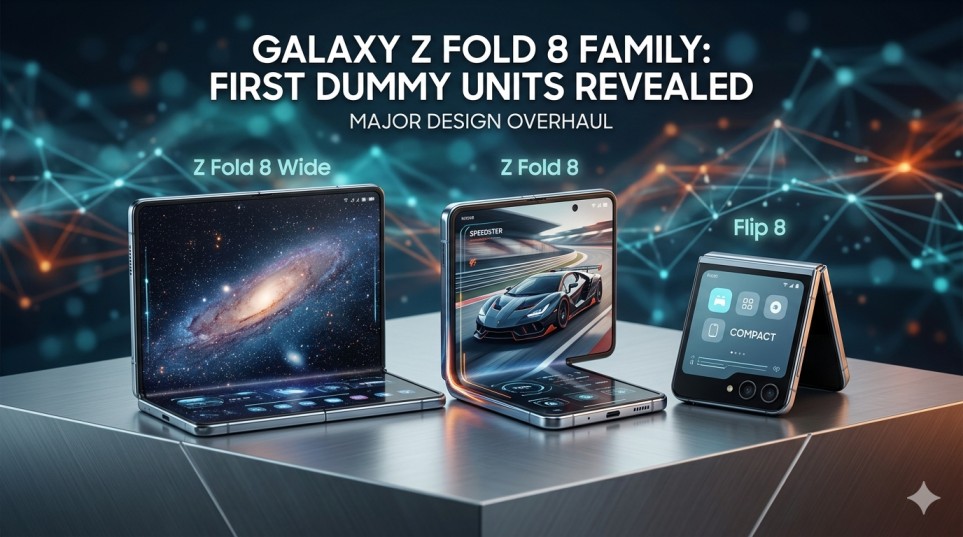
New images of leaked dummy units, shared by the reliable industry insider Sonny Dickson, provide a definitive look at the upcoming trio: the Galaxy Z Fold 8, the Galaxy Z Flip 8, and the brand-new Galaxy Z Fold 8 Wide.
Table of Contents
The Showstopper: Galaxy Z Fold 8 Wide
The biggest surprise is the Fold 8 Wide. While the standard Fold 8 maintains its signature tall look, the “Wide” variant adopts a “passport-style” form factor.
- Aspect Ratio: It features a rumored 4:3 inner display, making it feel more like a mini-tablet (similar to the iPad Mini or the Pixel Fold) rather than a narrow phone.
- Dimensions: It stands shorter at 123.9mm but spans a massive 161.4mm when unfolded.
- Ultra-Slim Build: Despite its width, it is incredibly thin at just 4.3mm when open, making it one of the thinnest foldables in the world.
While Samsung is dominating the foldable market with the Galaxy Z Fold 8 Wide, other tech giants are also preparing their 2026 flagship contenders. If you are looking for a more traditional “Pro” smartphone experience with industry-leading camera optics, don’t miss our deep dive into Sony’s upcoming beast.
Read More: Sony Xperia 1 VIII Preview: What to Expect from the Next Camera King?
Qi2 Magnetic Charging: The “MagSafe” Era Arrives?
One of the most interesting details visible on the dummy units is a circular cutout on the back of all three devices.
- Native Magnets: This strongly suggests that Samsung is finally integrating Qi2 magnetic wireless charging.
- Benefit: This will allow for MagSafe-style accessories—like snap-on batteries, wallets, and car mounts—without needing a special case.
The Trio Lineup: A New Strategy for 2026
For years, Samsung followed a two-pronged approach: the Fold for power users and the Flip for style-conscious consumers. However, with intense competition from Chinese manufacturers and the looming threat of a foldable iPhone, Samsung is diversifying.
The leaked dummy units confirm that the “Wide” model isn’t just a rumor; it’s a physical reality. This gives users a choice between the traditional tall form factor and a new, tablet-like experience.
Quick Comparison: Fold 8 vs. Fold 8 Wide
📱 Fold 8 vs Fold 8 Wide
The Galaxy Z Flip 8: Refinement over Revolution
The dummy units show the Galaxy Z Flip 8 sticking to its successful folder-shaped cover screen. However, the edges appear even flatter than the Flip 7, and the hinge looks nearly invisible when closed. Like its larger siblings, it also sports the magnetic ring for Qi2 charging.
Looking Back: The Foundation of Fold 8 To understand how far Samsung has come with the Galaxy Z Fold 8 Wide, it is essential to look at its predecessors. The previous generation set a high bar for durability and performance, laying the groundwork for the massive design changes we see today.
Read More: Galaxy Z Fold 7 & Flip 7: Samsung’s Best Foldables Yet? Features, Specs, and Review
Samsung Galaxy Z Fold 8 vs. Fold 7 vs. Fold 6: Major Upgrades and Comparison
The recent leak of Galaxy Z Fold 8, Fold 8 Wide, and Flip 8 dummy units has sent shockwaves through the tech community. While Samsung has often been criticized for “incremental” updates, 2026 marks a massive shift in design philosophy.
If you are currently using a Fold 6 or Fold 7, here is exactly how the upcoming lineup compares to its predecessors.
1. Galaxy Z Fold Series: The Battery & Power Evolution
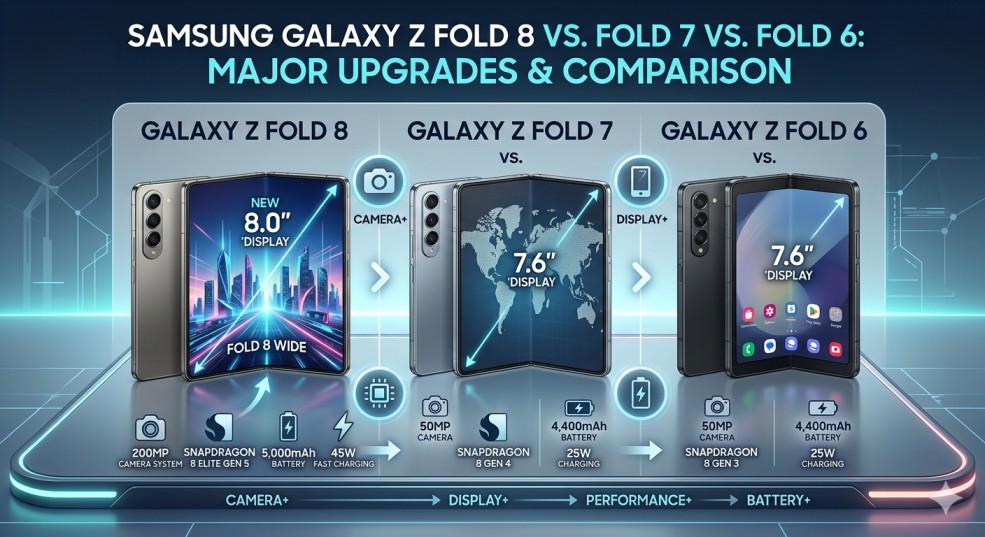
The most significant complaint regarding the Fold 6 and 7 was the stagnant 4,400 mAh battery. The Galaxy Z Fold 8 finally addresses this, alongside a massive jump in charging speed.
Many users have stayed with their Fold 6 or Fold 7 because they felt the upgrades weren’t “big enough.” The Fold 8 changes that narrative by fixing the two biggest pain points: Battery Life and Camera Quality.
🔄 Galaxy Z Fold: 3-Year Evolution
25W
25W
45W Fast
The Verdict: The Fold 8 is a “true” upgrade. With a 13% larger battery and the jump to a 200MP camera, it moves from being a productivity tool to a photography powerhouse.
Battery Performance & Optimization: With a bigger 5,000mAh battery and a massive 8-inch display on the Galaxy Z Fold 8 Wide, managing power efficiency becomes crucial. Even with the most advanced hardware, software issues can often lead to rapid power loss. If your current device is struggling to stay powered on throughout the day, check out our comprehensive guide on how to fix common battery issues.
Read More: Is Your Mobile Battery Draining Fast? Top Reasons and How to Fix It Easily
2. Galaxy Z Flip 8: Refined Aesthetics
The Flip 8 dummy units suggest Samsung is prioritizing battery life and a “gapless” flat design over radical screen changes.
- Cover Display: Incremental growth from the Flip 7’s 4.0-inch to a 4.1-inch bezel-less exterior screen.
- Charging: Adoption of Qi2 Magnetic charging, allowing you to use magnetic wallets and battery packs directly on the back of the phone.
- Durability: A new Armor Aluminum 3.0 frame, making it more resistant to drops than the Flip 6 and 7.
3. The “Wide” Factor: Z Fold 8 vs. Z Fold 8 Wide
For the first time, Samsung users have a choice in shape. The leaked dummy units show that the “Wide” model is not just a bigger Fold—it’s a different experience entirely.
- The Passport Design: The Fold 8 Wide is significantly shorter (123.9mm) than the standard Fold 8. This makes the outer screen feel like a normal smartphone rather than a “remote control.”
- Multitasking: The 4:3 aspect ratio on the inner screen is optimized for document editing and split-screen apps, directly challenging the rumored Apple Foldable designs.
- Portability: At just 4.3mm thin, the Wide model is designed to disappear into your pocket despite its increased width.
Why This Matters for Your Next Purchase
If you have been holding onto your Galaxy Z Fold 6, the 2026 lineup is the perfect time to upgrade. You aren’t just getting a faster processor (Snapdragon 8 Gen 5); you are getting:
- Magnetic Ecosystem: No more fumbling with wireless charging alignment.
- All-Day Battery: Finally, a Foldable that matches the S26 Ultra in endurance.
- Form Factor Choice: You can finally choose between a “Tall” or “Wide” foldable based on how you use your phone.
Price and Availability
Galaxy Z Fold 8 & Flip 8: Global Expected Price (2026)
💰 Galaxy Z8 Series: Global Price
*Nepal pricing includes estimated taxes and import duties.
Important Notes for Price
- Price Hike Alert: Global chip shortages and the transition to 2nm processors (Exynos 2600 / Snapdragon 8 Elite Gen 5) might cause a slight price increase of around $80-$100 compared to last year.
- The “Wide” Factor: The Galaxy Z Fold 8 Wide is expected to be the most expensive model due to its new aspect ratio and larger battery.
- Launch Date: These prices are for the base 256GB variants. Expect to pay more for 512GB or 1TB storage options.
Foldable Innovation: Budget vs. Luxury While the Galaxy Z Fold 8 series represents the peak of mainstream foldable technology, there is an even more exclusive world of luxury foldables. If you think the Z Fold 8 is premium, you should see how a phone can cost as much as a small car.
Read More: An $8,000 Flip Phone? The Vertu Quantum Flip Explained: Features, Specs, and Why It Costs a Fortune
Final Verdict: Should You Wait for the 2026 Lineup?
Samsung is clearly moving to compete with the rumored “iPhone Fold” and Chinese rivals like Huawei by offering different shapes for different users. Whether you want a productivity beast (Fold 8), a pocketable classic (Flip 8), or a mini-tablet (Fold 8 Wide), 2026 is shaping up to be the biggest year for foldables yet.
If you are on a Galaxy Z Fold 6 or older, the jump to the Fold 8 series will feel like night and day. Between the 200MP camera, the Qi2 magnetic ecosystem, and the choice of a “Wide” form factor, Samsung has finally delivered the “Ultra” foldable experience we have been waiting for.
For phadera.com readers, keep an eye on the July 2026 Unpacked Event. These dummy units are almost certainly the final design we will see on stage.
FAQs
What are the common issues with Samsung Z Fold?
While Samsung has improved durability, common issues often include the internal screen protector peeling over time, a noticeable display crease, and higher repair costs compared to standard phones. Some users also report hinge stiffness or dust accumulation in earlier models, though the Z Fold 8 aims to address these with better IP ratings.
What will the Z Fold 8 look like?
Based on the first dummy units, the Galaxy Z Fold 8 will feature a significant design shift. The new Z Fold 8 Wide model is expected to have a broader aspect ratio, making the cover screen feel like a traditional smartphone. Reports suggest a thinner titanium frame, a more integrated hinge, and a larger internal display with reduced bezels.
Does the Z Fold 8 have an S Pen?
Yes, the Z Fold 8 supports the S Pen, but current dummy leaks suggest it will likely not have a built-in slot (silo) to keep the device thin. Users will likely need a specialized case to carry the stylus, similar to previous generations, although the digitizer has been upgraded for better latency and pressure sensitivity.
When is the Samsung Galaxy Z Fold 8 release date?
Samsung is expected to launch the Galaxy Z Fold 8, Fold 8 Wide, and Flip 8 in July 2026 at the Samsung Unpacked event. Based on recent leaks, the event might be held on July 22, 2026, with official sales starting in early August.
What is the expected price of the Galaxy Z Fold 8?
The starting price for the Galaxy Z Fold 8 is rumored to be $1,999 (approx. NPR 2,65,000) for the 256GB model. However, higher storage variants like the 512GB and 1TB models might see a price hike of around $80 compared to the previous generation.
What are the key upgrades in the Galaxy Z Fold 8 Wide?
The Z Fold 8 Wide is the biggest highlight of 2026. It features a shorter, wider aspect ratio (similar to the Pixel Fold), a massive 8-inch inner display, and a significantly larger 5,000mAh battery with 45W fast charging support.
Will the Galaxy Z Fold 8 have a crease-less display?
Yes, internal reports suggest Samsung will use a new “dual-glass” display technology showcased at CES 2026. This technology aims to make the screen crease almost invisible while increasing the overall durability of the foldable panel.
What are the camera specifications for the Z Fold 8?
The Z Fold 8 is tipped to feature a flagship-grade camera system: a 200MP main sensor, an upgraded 50MP ultra-wide lens, and a 12MP telephoto lens with 3x optical zoom. This makes it one of the most powerful camera setups in a foldable device to date.

Dal Bahadur is a passionate tech enthusiast, hardware reviewer, and the founder of Phadera Tech. With years of experience in mobile technology and digital troubleshooting, he specializes in deep-dive smartphone reviews, gadget guides, and practical tech tips. His goal is to help readers make informed decisions before buying their next gadget.