
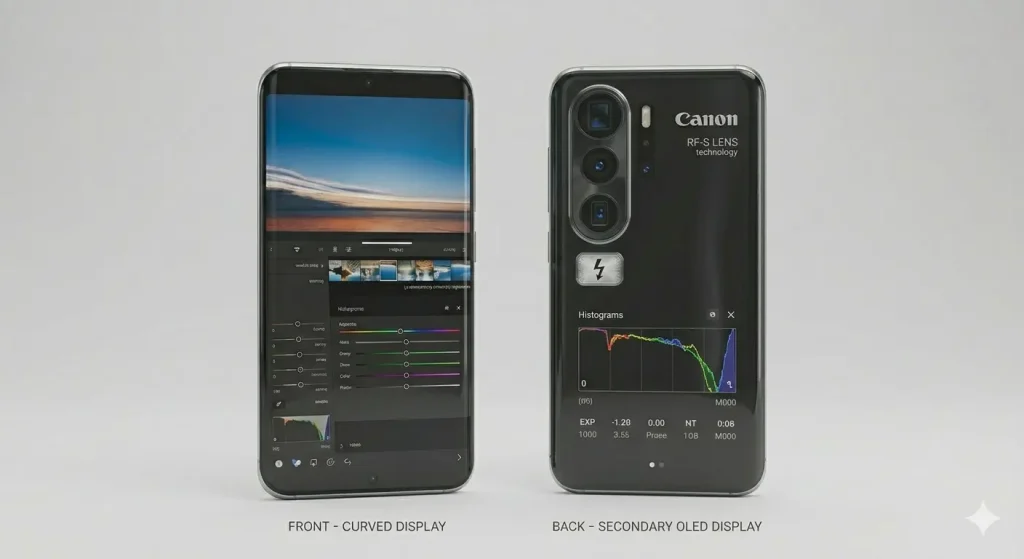
For over eight decades, one name has reigned supreme in the world of imaging: Canon. From professional-grade DSLRs to ubiquitous consumer point-and-shoots, and the cutting-edge mirrorless EOS R system, Canon is synonymous with quality glass, legendary color science, and reliable performance. However, as of May 2026, a gaping void exists in their sprawling portfolio. They do not make a canon smartphone.
The smartphone market itself is a mature, hyper-competitive battleground. Dominance is split between tech giants Apple and Samsung, with aggressive innovators like Xiaomi, Vivo, and Oppo fighting for market share, often by leveraging partnerships with legacy camera brands like Leica, ZEISS, and Hasselblad. Sony remains the singular outlier—a traditional camera powerhouse that also manufactures smartphones, though focusing on a niche, prosumer audience.
While we wait for a potential entry from Canon, the “Pro Camera” smartphone niche is currently dominated by Sony. If you are looking for a device that offers professional manual controls and Alpha-series DNA right now, the Sony Xperia 1 VIII is the closest experience to a traditional camera in a mobile form factor.
Check out our detailed analysis here: Sony Xperia 1 VIII Preview: The Ultimate Pro-Camera Alternative
This article explores a hypothetical scenario that has fascinated tech enthusiasts and photographers for years: What if Canon finally broke its silence and decided to enter the smartphone industry in 2026? Such a move wouldn’t merely be a new product launch; it would be a seismic event, redrawing the boundaries of mobile photography and posing a direct threat to the established luxury phone market.
Table of Contents
A Legacy of Imaging: Canon’s Foundation
Before analyzing the future, we must acknowledge the foundation. Canon’s journey began in 1933 as Precision Optical Instruments Laboratory, dedicated to researching quality cameras. Their first production model, the Kwanon (named after the Buddhist Goddess of Mercy), laid the groundwork for decades of innovation.
Canon’s modern dominance is built upon several core pillars:
- Optical Excellence: Their EF (and now RF) lens mounts represent billions of dollars in R&D, producing some of the sharpest, most technologically advanced glass in history. The iconic “Red Ring” on an L-series lens is a universal symbol of professional performance.
- Color Science: Canon has a proprietary way of interpreting light and data, known affectionately as “Canon Color Science.” It is celebrated for producing flattering, natural skin tones and rich, pleasing colors directly out-of-camera, a feat many smartphone AIs still struggle to replicate.
- Sensor Innovation: Canon develops its own CMOS sensors, pushing boundaries in dynamic range, low-light performance, and speed, including the groundbreaking Dual Pixel CMOS AF, which revolutionized autofocus in video.
This DNA—glass, color, and focus—is exactly what the saturated smartphone market is missing in its quest for photographic parity.
The Current Landscape: Partnerships vs. Purity
By 2026, the intersection of cameras and phones has become normalized. We see “Co-engineered with Leica” on Xiaomi flagships, “ZEISS T* Coating” on Vivo phones, and “Hasselblad Camera for Mobile” on OnePlus and Oppo.
These partnerships provide marketing prestige and computational assistance, but they are collaborations, not vertical integrations. The hardware, manufacturing, and user interface are still managed by a phone company.
Sony is the exception. The Sony Xperia 1 series is built by Sony, using Sony Alpha engineers to design the interface and camera pipeline. It is the closest analog to a “camera company phone,” yet it remains a niche product, often criticized for being overly complex for the average user.
A Canon Smartphone, vertically integrated and built from the ground up by imaging engineers, would be unique. It would not rely on a partner’s reputation; it is the reputation.
Disrupting the Titans: Direct Competition
If Canon were to enter this market, they wouldn’t target the mid-range. A “Canon Phone” would be a premium, luxury-tier device, positioned as an alternative to the top flagships from Apple, Samsung, and Sony.
- The Apple Challenge (iPhone 17 Pro Max/Ultra): Apple dominates with ecosystem integration and unparalleled computational video. Canon would counter not with AI tricks, but with raw hardware power. It would offer superior optics, larger sensors, and the “flattering” Canon color science that makes portraits look professional without heavy editing. Canon could position itself as the phone for creators who care about authenticity.
- The Samsung Challenge (Galaxy S26 Ultra): Samsung is the king of versatility, known for incredible zoom range. Canon, the master of precision glass, could introduce a multi-camera array using true variable optical zoom, avoiding the image quality loss typical of digital cropping between Samsung’s fixed focal lengths.
- The Sony Challenge (Xperia 1 VIII): Canon would go head-to-head with its closest rival, offering a more user-friendly interface that balances Sony’s “pro-manual” controls with Canon’s legendary usability.
Chart 1: Competitive Landscape 2026 (Hypothetical)
📸 Flagship Camera Battle
Expected Specifications and Design: A Luxury Blueprint
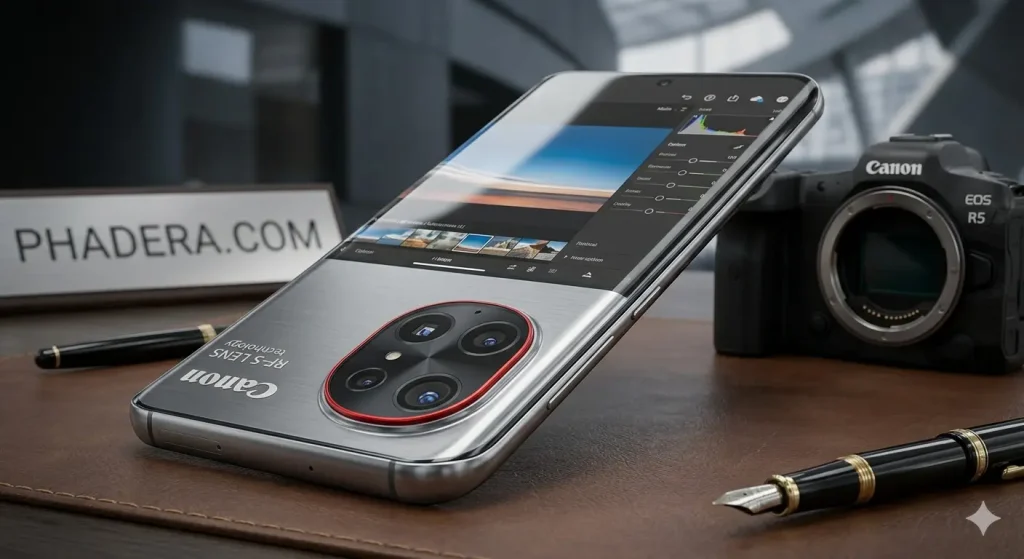
A Canon smartphone wouldn’t be a generic black slab. It would be a professional tool designed with Canon’s signature luxury and durability.
- Design Aesthetics: We can imagine a device using lightweight but ultra-durable alloys, perhaps magnesium or titanium, with an accent modeled after the ergonomic grip of an EOS R camera. It might subtly incorporate the “Red Ring” aesthetic around the main camera module, signaling its L-series heritage.
- Optics: This would be its primary differentiator. Instead of four standard camera modules, Canon might develop a highly engineered triple camera system using internal moving glass elements for true variable optical zoom (e.g., smoothly moving from 24mm to 70mm equivalent).
- Display: A top-tier, factory-calibrated OLED panel with infinite dynamic range, optimized for viewing and editing HDR photographs.
- Connectivity: Seamless integration with existing Canon smartphone software (Camera Connect) and professional cloud services, allowing a phone to function as a lag-free 6K external monitor or primary controller for a cinema camera rig.
Pros and Cons: The Hypothetical Reality Check
The potential benefits of Canon entering the market are clear, but the risks are substantial.
Advantages (Pros):
- Color Science Mastery: Canon skin tones would set a new market standard, making portraits look effortlessly professional.
- Optical Physics: Precision glass elements could reduce artifacts, flares, and distortion that AI struggling to fix.
- Vertical Integration: Controlling the lens, the sensor, and the color science means a unified imaging pipeline.
- Brand Loyalty: Millions of Canon shooters worldwide would jump at the chance to own an “all-Canon” ecosystem.
Disadvantages (Cons):
- The Software Chasm: Designing a functional mobile OS (likely an Android skin) requires entirely different skillsets than camera firmware.
- Manufacturing Scale: Phone companies make millions of units; Canon makes hundreds of thousands. Scaling up involves massive risk and potential quality control issues.
- Form Factor vs. Physics: Shrinking Canon’s optical excellence into a 7mm thin device might require unacceptable compromises that damage the brand’s reputation.
Chart 2: SWOT Analysis of Canon Entering Smartphone Market
📊 Canon Mobile: SWOT Analysis
- Imaging Expertise (Decades of R&D)
- Vast Optical Patents & Glass Tech
- Strong Global Brand Reputation
- Lack of OS/Software Ecosystem Experience
- Limited Experience in Mobile Miniaturization
- High Entry Cost for Mass Scale R&D
- Professional Creator Market (TikTok/YouTube)
- Demand for Authentic/Non-AI Photography
- Luxury Tech Sector Growth
- Dominance of Apple & Samsung
- Rapid Phone Innovation Cycles
- Global Supply Chain Vulnerabilities
Expected Price and Target Audience
A Canon phone would be a luxury, professional-grade statement piece. It wouldn’t be priced competitively with the entry-level flagships; it would be priced alongside the absolute top tiers.
- Estimated Price: $1,699 – $1,999 USD (matching iPhone 17 Pro Ultra or Galaxy S26 Ultra 1TB).
- Target Audience:
- Professional photographers needing a secondary, reliable ‘pocket camera’ with predictable color science.
- Content creators and videographers who value true optical quality and manual control over AI processing.
- Luxury tech enthusiasts who value craftsmanship and engineering over pure convenience.
When discussing a device that could cost nearly $2,000, we have to look at the luxury phone market. While Canon would focus on optical luxury, other brands focus on material and status. For instance, the Vertu Quantum Flip takes the concept of a high-end device to an entirely different level with its $8,000 price tag. Understanding what makes a phone “worth a fortune” helps put the potential value of a Canon flagship into perspective.
Read our full breakdown here: An $8,000 Flip Phone? The Vertu Quantum Flip Explained
Conclusion: Will the King Ever Rule the Pocket?
As of 2026, Canon remains the “King of Cameras” by traditional standards. However, the smartphone has replaced the camera for 95% of all imaging needs. The hypothetical Canon smartphone is the industry’s ultimate “What If?”
If it existed, it would likely be a stunning technical achievement—a device built by masters of light, prioritized for the authenticity of the captured moment, and engineered to directly challenge the established luxury players. It would force Apple and Samsung to move beyond computational tricks and return to the fundamentals of glass and light.
For now, this device remains a concept, perhaps on a whiteboard in Tokyo. Until then, Canon’s influence in the smartphone world is complementary, providing apps and potential sensor partnerships. But if the King ever decides to enter the arena, the smartphone industry should be ready to redraw its maps.
People Also Ask (FAQs) – Canon Smartphone 2026
Is Canon releasing a smartphone in 2026?
As of May 2026, Canon has not officially announced any plans to launch a smartphone. While there are many “Canon Smartphone” concepts and rumors among tech enthusiasts, Canon remains focused on its professional EOS R mirrorless cameras and optical technologies. However, they continue to innovate in mobile-related imaging sensors and software.
Why doesn’t Canon make smartphones?
Canon focuses on high-end optical physics and professional imaging tools. The primary challenge is fitting their large, high-performance sensors and glass lenses into a thin smartphone body without compromising quality. Canon views smartphones as complementary devices rather than direct competitors to their professional DSLR and mirrorless lineups.
Which is the best camera phone in 2026 as an alternative to Canon?
If you are looking for a professional-grade camera experience in a phone, the top contenders in 2026 are:
Sony Xperia 1 VIII: Known for its Alpha-style manual controls.
Xiaomi 16 Ultra: Featuring Leica-tuned optics and 1-inch sensors.
Vivo X200 Pro: Utilizing ZEISS T* coating for superior lens clarity.
Samsung Galaxy S26 Ultra: The leader in hybrid zoom and versatility.
Would a Canon smartphone have “Red Ring” lenses?
In a hypothetical scenario, a Canon flagship smartphone would likely feature L-series (Luxury) optics, represented by the iconic “Red Ring.” This would signal the use of premium precision glass elements, designed to provide superior sharpness and reduce chromatic aberration compared to standard mobile lenses.
How much would a Canon Smartphone cost?
Given Canon’s brand positioning as a premium imaging leader, a Canon smartphone would likely be priced in the Luxury Segment. Industry experts estimate a starting price between $1,699 and $1,999 USD, putting it in direct competition with the Apple iPhone 17 Pro Ultra and Samsung Galaxy S26 Ultra.
Can I use Canon lenses on a smartphone?
Currently, you cannot natively mount Canon EF or RF lenses on a smartphone. However, you can use the Canon Camera Connect app to wirelessly transfer high-quality photos from your Canon camera to your phone for instant editing and sharing on social media.

Dal Bahadur is a passionate tech enthusiast, hardware reviewer, and the founder of Phadera Tech. With years of experience in mobile technology and digital troubleshooting, he specializes in deep-dive smartphone reviews, gadget guides, and practical tech tips. His goal is to help readers make informed decisions before buying their next gadget.