
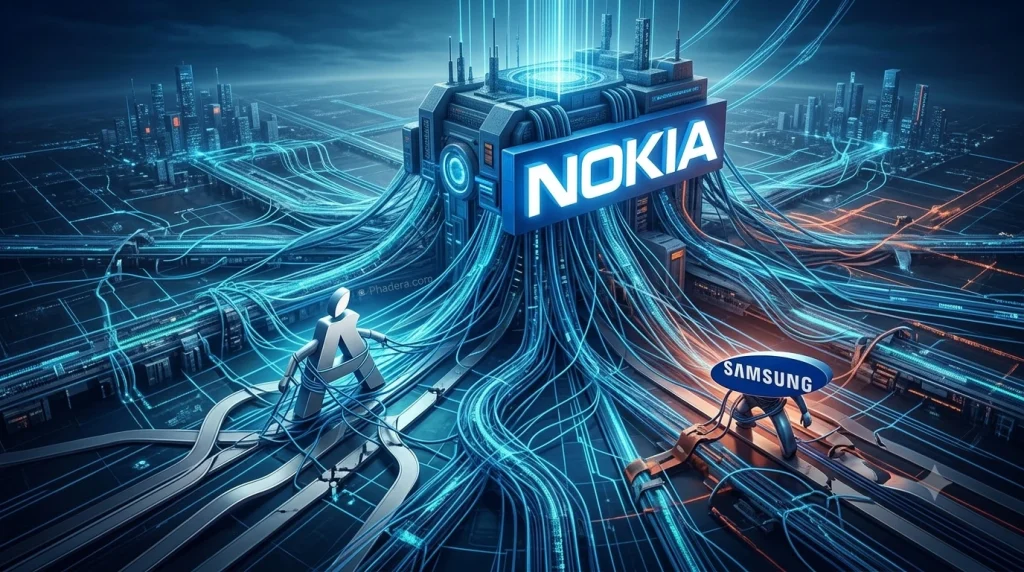
Behind the scenes of global telecommunications lies the Nokia Master Plan—a strategy that allows a former phone manufacturer to control the smartphone industry without selling handsets. To the public, Nokia is a nostalgic memory of indestructible feature phones. To Apple and Samsung, it is an unassailable patent tollbooth collecting billions in recurring royalties.
When you buy a $1,200 Apple iPhone 15 Pro or a $1,300 Samsung Galaxy S24 Ultra, a portion of that retail price goes directly to Nokia’s bank account in Espoo, Finland.
How does a company with zero consumer smartphone market share force trillion-dollar tech titans to hand over billions in royalty checks? The answer lies in Standard-Essential Patents (SEPs) and the governing framework of FRAND (Fair, Reasonable, and Non-Discriminatory) licensing.
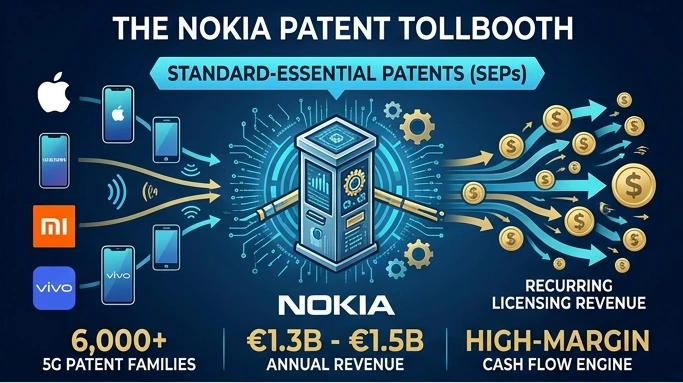
THE NOKIA TOLLBOOTH
Nokia Technologies & Bell Labs R&D Pipeline
Fueling the ecosystem through heavy long-term innovation.
€150B+ Cumulative R&D Investment → 20,000+ Patent Families
3GPP & ETSI Standard-Essential Patents (SEPs)
Foundational patents governing global wireless communications.
6,000+ 5G SEPs: Signal, Antenna, Video & Audio
Global Hardware Licensees
Every major tech giant must license Nokia IP to build 5G devices:
Recurring High-Margin Cash Flow Engine
Near 90% operating margin generated with zero manufacturing expense.
€1.3B – €1.5B Annual Net Licensing Run-Rate
1. Standard-Essential Patents (SEPs): The Foundation of Connectivity
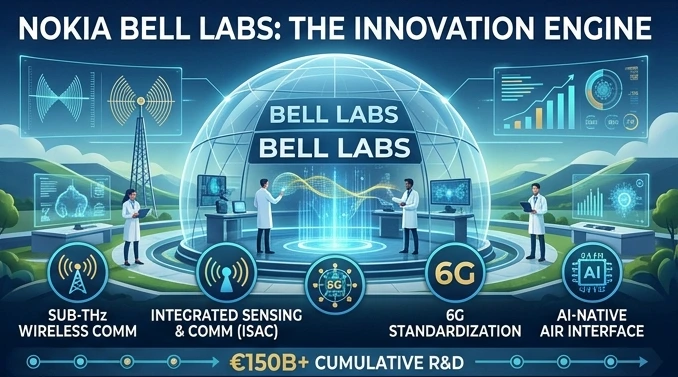
To ensure modern telecommunications function seamlessly across the globe, industry bodies like 3GPP (3rd Generation Partnership Project) and ETSI (European Telecommunications Standards Institute) set universal technical specifications.
At the core of the Nokia Master Plan is a clever legal and technological framework built on Standard-Essential Patents (SEPs)
- The Reality: You cannot build a 5G-compliant smartphone without infringing on Nokia’s SEPs.
- The Portfolio: Nokia holds over 20,000 patent families, including more than 6,000 patent families declared essential to 5G alone.
- The R&D Moat: Nokia’s patent moat was built on over €150 billion (~$165 billion USD) invested in research and development since the year 2000.
2. The Legal Hammer: German Injunctions and International Ban Threats
Apple and Samsung do not pay Nokia out of goodwill; they pay because Nokia possesses legal leverage.
When multi-year cross-licensing deals expire, smartphone manufacturers often resist Nokia’s requested royalty rates, triggering court battles. Nokia’s strategy in these negotiations follows a proven model:
- Strategic Litigation: Nokia files patent infringement lawsuits in pro-patent jurisdictions like Germany (Munich, Mannheim, Düsseldorf courts), the UK High Court, and the U.S. International Trade Commission (ITC).
- Sales Injunctions: German courts enforce strict patent protections. In recent years, Nokia successfully obtained sales injunctions against major Chinese manufacturers (including OPPO and Vivo), temporarily banning their smartphones from sale in Germany until new licensing agreements were signed.
- The Settlement: Faced with an emergency ban on selling flagship devices in major European or American markets, tech giants yield and sign multi-year licensing deals.
In mid-2023, Apple renewed its long-term patent license agreement with Nokia (effective January 2024), covering 5G and wireless innovations. Early in 2023, Samsung signed a multi-year 5G patent license agreement with Nokia. By early 2024, Nokia announced the conclusion of its entire smartphone license renewal cycle, securing long-term recurring cash flow without spending a dollar on device manufacturing, shipping, or consumer marketing.
Nokia’s Financial Engine: Breaking Down the Real Numbers
Nokia is not a struggling legacy brand; it is a highly profitable, enterprise-focused B2B infrastructure giant.
Nokia Group Financial Overview (Latest Data Insights)
Nokia Group Financial Overview
Financial Metric |
Reported Figure |
Strategic Significance |
|---|---|---|
Annual Group Revenue |
€19.2 Billion+ |
Driven by telecom infrastructure and IP licensing. |
Technologies Run-Rate |
€1.3B – €1.5B |
Pure, high-margin patent licensing net sales. |
Cumulative R&D Investment |
€150B+ (Since 2000) |
The capital backbone sustaining its patent portfolio. |
5G Patent Families |
6,000+ Essential |
Dominant share in global 5G communications IP. |
Private Wireless Clients |
850+ Enterprise |
Industrial networks across mining, ports, and logistics. |
Full Year Operating Profit |
€2.0 Billion+ |
Strong profit margins driven by high-margin IP licensing. |
Unlike hardware manufacturing—which carries high bill-of-materials (BOM) costs, supply chain risks, retail margins, and warranty liabilities—Nokia Technologies operates with near-90% operating margins. The cash flow generated from licensing fees directly funds basic scientific research at Nokia Bell Labs, generating new patents for 6G, industrial IoT, and optical communications. The financial results of the Nokia Master Plan speak for themselves: high-margin licensing cash flows fund continuous scientific research while avoiding hardware liabilities.
The Four Pillars of the Nokia Master Plan
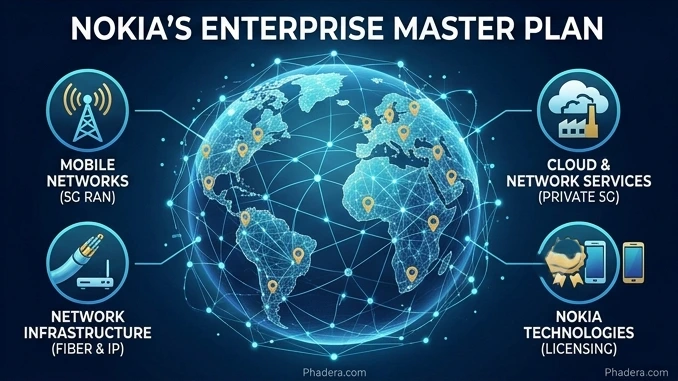
To maintain long-term dominance without consumer hardware, the Nokia Master Plan relies on four distinct enterprise pillars.:
Pillar 1: Network Infrastructure (Fixed, Optical, and IP Routing)
While consumer traffic surges due to AI workloads, 4K streaming, and cloud computing, the backhaul fiber and optical networks carrying this data must expand. Nokia is a global leader in:
- IP Routing: High-performance routing chips (such as the FP5 network processing silicon) powering data center interconnects and carrier backbones.
- Optical Networks: Ultra-high-speed submarine cables and terrestrial optical lines.
- Fixed Access: Fiber-to-the-home (FTTH) infrastructure (XGS-PON technologies).
Pillar 2: Mobile Networks (5G RAN & Open RAN Leadership)
Nokia supplies the physical Radio Access Network (RAN) equipment—base stations, massive MIMO antennas, and radio heads—used by major telecom operators worldwide (such as T-Mobile, AT&T, Vodafone, Bharti Airtel, and SoftBank).
As operators shift toward Open RAN (ORAN) architecture, Nokia has repositioned itself to provide virtualized base station software compatible with third-party radio hardware.
Pillar 3: Cloud and Network Services (Enterprise & Private 5G)
Public mobile networks are only half of Nokia’s market opportunity. Industrial facilities—such as smart factories, automated ports, underground mines, and airport logistics centers—require dedicated private wireless networks.
- Nokia has deployed over 850 private wireless networks globally.
- Mining automation giant Rio Tinto, automotive factories, and modern container ports run on Nokia Private 5G networks, bypassing public cellular providers for zero-latency, secure industrial control.
Pillar 4: Nokia Technologies (Expanding Patent Licensing Beyond Phones)
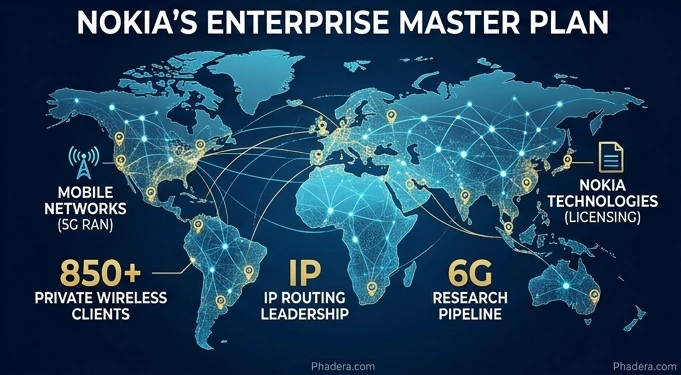
Having secured multi-year agreements across the smartphone market, Nokia Technologies is expanding its IP licensing model into new industries:
- Connected & Autonomous Vehicles: Modern electric and autonomous cars require 5G connectivity for telemetry, OTA updates, and V2X (Vehicle-to-Everything) safety. Nokia licenses patents to major automakers (including Mercedes-Benz, BMW, Volkswagen, and Toyota).
- Smart Home & Consumer Electronics: Smart TVs, set-top boxes, and streaming devices using video compression standards (such as HEVC/H.265 and VVC/H.266) pay licensing fees to Nokia.
- IoT & Industry 4.0: Millions of smart meters, connected industrial sensors, and logistics trackers pay incremental royalties to Nokia.
Strategic Summary: Why Nokia Remains Unassailable
Nokia’s pivot offers a clear business lesson: consumer brands are fragile, but technological standards are enduring. As telecommunications move toward 6G, the Nokia Master Plan ensures that Nokia will remain an indispensable bottleneck power in global tech for decades to come.
By exiting the razor-thin margin consumer smartphone market, Nokia avoided the fate of BlackBerry or HTC. Instead, it transformed itself into a digital landlord. As 5G expands into 6G, automated transport, and AI network backbones, every major tech titan will continue paying tribute to the infrastructure built in Espoo and Nokia Bell Labs.
Frequently Asked Questions (FAQ)
Does Nokia still make smartphones today?
No, Nokia Corporation does not manufacture or sell consumer smartphones. In 2014, Nokia sold its mobile hardware division to Microsoft. While phones with the “Nokia” brand name exist in the market, they are produced under a brand licensing agreement by an independent Finnish company called HMD Global. Nokia Corporation focuses entirely on B2B telecommunications, network infrastructure, private enterprise 5G, and intellectual property licensing.
How much money does Nokia make from Apple and Samsung?
The intellectual property division driving the Nokia Master Plan (Nokia Technologies) generates between €1.3 billion and €1.5 billion annually in high-margin net sales. A significant share of this recurring revenue comes from multi-year licensing deals signed with major smartphone giants, including Apple, Samsung, Xiaomi, OPPO, and Vivo.
What is a Standard-Essential Patent (SEP)?
A Standard-Essential Patent (SEP) is a patent that covers technology essential to implementing an agreed-upon international technical standard, such as 3G, 4G LTE, 5G, or Wi-Fi. Because a device cannot comply with 5G specifications without using these fundamental inventions, manufacturers must obtain a license from patent holders like Nokia.
What are FRAND terms in patent licensing?
FRAND stands for Fair, Reasonable, and Non-Discriminatory. Because Standard-Essential Patents give companies significant leverage, international standards bodies require patent owners to license essential connectivity patents to any manufacturer under fair and non-discriminatory financial terms. This prevents patent holders from blocking competition while ensuring they are compensated fairly for R&D.
Why can’t Apple or Samsung build smartphones without Nokia’s patents?
Nokia Bell Labs has invested over €150 billion in research and development since 2000, creating foundational technologies that dictate how signals are compressed, transmitted, and received across cell towers. Because these innovations were integrated into international 3GPP and ETSI standards, any 5G-compliant modem or device inherently infringes on Nokia’s essential patents if manufactured without a license.
How does 6G fit into the future of the Nokia Master Plan?
The next phase of the Nokia Master Plan centers on research at Nokia Bell Labs into 6G standards—specifically sub-Terahertz (90–300 GHz) wireless communications and Integrated Sensing and Communication (ISAC). By securing foundational patents early in the 6G development cycle, Nokia ensures its high-margin licensing model will continue when 6G commercializes around 2030.
What is the Nokia Master Plan in modern tech?
The Nokia Master Plan refers to Nokia’s strategic transformation from a low-margin consumer smartphone maker into a high-margin digital landlord. Instead of manufacturing handsets, Nokia monetizes over 20,000 patent families (including 6,000+ 5G Standard-Essential Patents) and provides enterprise-grade B2B network infrastructure worldwide.
ow does the Nokia Master Plan force Apple and Samsung to pay royalties?
Under the Nokia Master Plan, Nokia holds foundational wireless patents established by global telecommunications bodies like 3GPP and ETSI. Because no smartphone manufacturer can produce a 5G-compliant device without using these essential technical specifications, tech giants like Apple, Samsung, and Xiaomi must sign multi-year licensing deals under FRAND terms to avoid sales injunctions in key courts.

Dal Bahadur is a passionate tech enthusiast, hardware reviewer, and the founder of Phadera Tech. With years of experience in mobile technology and digital troubleshooting, he specializes in deep-dive smartphone reviews, gadget guides, and practical tech tips. His goal is to help readers make informed decisions before buying their next gadget.