
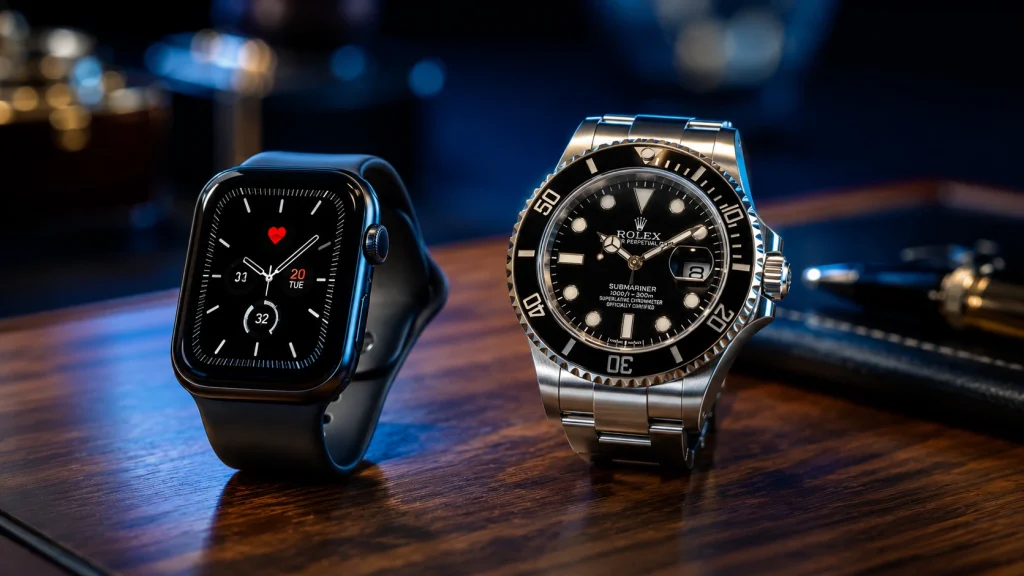
Ever wondered why luxury watchmakers don’t make smartwatches despite tech giants dominating the wristwear market? Walk into any electronics store, and you will find Apple, Samsung, and Garmin battling fiercely for wrist space. Walk into any electronics store, and you will find tech giants—Apple, Samsung, Garmin, and Xiaomi—battling fiercely for space on your wrist. Apple alone ships tens of millions of Apple Watches every year, generating revenues that surpass many historic Swiss watchmaking houses combined.
Yet, if you look at the titans of horology—Rolex, Patek Philippe, Audemars Piguet, Rado, and Seiko—you will notice something striking: they are almost completely absent from the smartwatch market.
Why are the world’s most famous watch companies letting tech firms dominate wrist real estate? Is it stubbornness, fear of innovation, or a masterclass in long-term business strategy?
The short answer: Luxury watchmakers are not playing the same game as tech companies.
To understand why luxury horology brands refuse to make smartwatches, we must explore the clash between silicon and springs, planned obsolescence versus generational legacy, and why a $10,000 mechanical watch is actually a smarter purchase than a $1,000 digital wearable.
1. The Death of Value: Planned Obsolescence vs. Generational Legacy
To understand why Rolex will never release a “Rolex iWatch,” you must first understand the fundamental economic model of technology versus luxury.
The Lifetime Value Divide
The Tech Lifecycle (Buy, Use, Trash)
When analyzing why luxury watchmakers don’t make smartwatches, the first factor to consider is product. Consumer electronics operate on planned obsolescence. When you purchase a high-end smartwatch:
- The Lithium-ion battery degrades within 2 to 4 years.
- The onboard chipset becomes too slow for new software features.
- The operating system (OS) stops receiving security updates.
Within five years, even the most expensive gold-plated Apple Watch Edition becomes a paperweight. It drops to nearly zero monetary value because software moves forward relentlessly, leaving old hardware behind.
The Horological Lifecycle (Inherit, Pass Down)
Now consider a Patek Philippe, Rolex, or Grand Seiko:
- It contains no batteries, microchips, or pixels.
- It runs purely on mechanical energy transmitted through springs, gears, escape wheels, and balance wheels.
- A mechanical watch bought today will function identically in 100 years, provided it is periodically serviced by a watchmaker.
Key Takeaway: Patek Philippe’s famous marketing slogan states: “You never actually own a Patek Philippe. You merely look after it for the next generation.” You cannot pass a Series 5 smartwatch down to your grandchild; it won’t even turn on.
2. Silicon vs. Springs: The Master Craftsman Paradox
Why can’t a company like Rolex or Seiko just hire software engineers and build a smartwatch? Another critical reason why luxury watchmakers don’t make smartwatches involves the fundamental difference between silicon microchips and mechanical movements.
Because their entire supply chain, brand identity, and workforce are built around mechanical micro-engineering, not software architecture.
Craftsmanship vs. Silicon
Mechanical Horology vs. Wearable Micro-Tech
- Hand-finished tourbillons and complications
- Synthetic rubies (jewels) used as frictionless bearings
- Hand-polished bevels (artistic anglage finishing)
- Spring-wound kinetic storage (zero battery dependency)
- Mass-produced PCB microchips and microprocessors
- High-density OLED / AMOLED display panels
- Firmware & cloud APIs for real-time data sync
- Lithium-polymer battery chemical energy storage
The Art of Hand Finishing
A luxury watch movement can take months—sometimes years—to assemble by hand. Watchmakers spend hours under a microscope polishing microscopic gear teeth, hand-applying Côtes de Genève stripes, and beveling bridge edges. Customers do not pay $20,000 for a watch just to read the time; they pay for artistic mastery and micro-sculpture.
The Silicon Commodity
A smartwatch display is produced on a mass assembly line in factories that manufacture millions of screens a day. There is no individual soul or hand-craftsmanship in a printed circuit board (PCB).
If a heritage brand releases a smartwatch, it instantly cheapens its identity. It converts a company built on centuries of artisanal handiwork into a gadget reseller competing against mass-manufacturing powerhouses in Shenzhen and Cupertino.
3. Screen Fatigue and the Rise of “Digital Detox”
We spend 8 to 12 hours a day staring at laptop displays, smartphone screens, tablets, and televisions. Every notification triggers a small hit of cortisol and adrenaline. When analyzing why luxury watchmakers don’t make smartwatches, the first factor to consider is product lifespan.
Digital Overload vs. Analog Sanctuary
How your choice of wristwear impacts mental peace and screen exposure
Smartwatches are essentially tethers to our digital lives. They buzz when an email arrives, chime when a news alert breaks, and track your heart rate when you’re stressed—adding more screens to your daily routine. Beyond technology, consumer lifestyle explains why luxury watchmakers don’t make smartwatches. Modern professionals are looking for digital detox.
In contrast, a traditional analog watch offers a digital detox:
- It does not track your movements.
- It does not interrupt your conversations with email alerts.
- It simply displays time as a quiet, physical motion of sweeping hands.
For high-net-worth individuals, executives, and professionals, wearing an analog watch has become a subtle form of rebellion against constant digital connectivity. Silence and disconnection are the ultimate modern luxuries.
4. Margins, Ecosystems, and the Business Model Trap
Why don’t brands like Casio, Rado, or Tissot convert their entire catalog to smartwatches? Because the business economics are fundamentally different. Another critical reason why luxury watchmakers don’t make smartwatches involves the fundamental difference between silicon microchips and mechanical movements.
Tech Companies Need Ecosystems
Apple doesn’t sell the Apple Watch purely for hardware profit. The Apple Watch keeps you locked inside the iOS ecosystem—it pairs with your iPhone, integrates with Apple Fitness+, syncs with Apple Music, and stores data on iCloud.
Watchmakers Sell Standalone Art
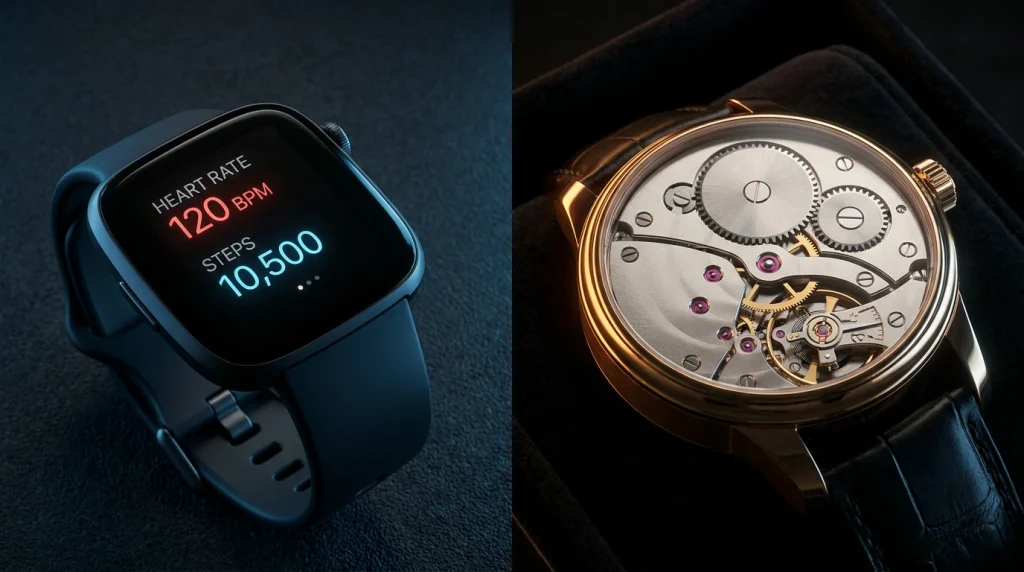
A company like Rado or Rolex does not have an app store, cloud server infrastructure, or cellular carrier partnerships. To build a competitive smartwatch, they would have to rely on third-party software—such as Google’s Wear OS.
Doing so puts them at the mercy of Google or third-party developers. If Google abandons Wear OS, or updates it in a way that breaks compatibility, the watchmaker’s reputation suffers. Heritage brands refuse to build their legacy on software platforms they do not own.
5. How Traditional Brands are Experimenting
While Rolex and Patek Philippe remain strictly analog, some traditional watchmakers have dipped their toes into digital waters—with mixed results.
1. TAG Heuer (TAG Heuer Connected)
TAG Heuer was one of the few Swiss luxury houses to jump into the smartwatch market early with the Connected series.
- The Strategy: They offered an upgrade program where users could trade in their obsolete smartwatch after a few years (plus a fee) for a mechanical TAG Heuer Carrera.
- The Result: It attracted tech-forward luxury buyers, but its resale value drops dramatically compared to their mechanical chronographs.
2. Casio (G-Shock & Pro Trek)
Casio approaches the smartwatch segment differently:
- Rather than making fragile touchscreens, Casio integrated solar power, Bluetooth time-sync, step counting, and GPS directly into their rugged G-Shock chassis.
- By retaining classic LCD/analog dials and ultra-durable resin/steel bodies, Casio created a “hybrid utility watch” rather than a frail touchscreen gadget.
3. Tissot (T-Touch Connect Solar)
Tissot developed its own low-power operating system (SwALPS) powered by solar cells under the dial. This hybrid design delivers notifications and fitness metrics while offering months of battery life without needing a wall charger.
The Watch Market Spectrum
Understanding the divide between consumer wearables, hybrid utility, and high horology
- • Apple Watch
- • Samsung Galaxy Watch
- • Garmin Fenix
- • Casio G-Shock Bluetooth
- • TAG Heuer Connected
- • Tissot T-Touch
- • Rolex Submariner
- • Patek Philippe Nautilus
- • Audemars Piguet Royal Oak
6. The Truth About Why Luxury Watchmakers Don’t Make Smartwatches
To ask why Rolex doesn’t make a smartwatch is like asking why Ferrari doesn’t build electric mobility scooters. Both move people, but they fulfill completely different human desires. why luxury watchmakers don’t make smartwatches is not a sign of falling behind, but a deliberate strategy to preserve timeless luxury.
Head-to-Head Comparison
The fundamental differences between modern wearables and traditional horology
Metric |
The Smartwatch
(Apple / Samsung / Garmin)
|
The Mechanical Watch
(Rolex / Seiko / Patek)
|
|---|---|---|
Primary Purpose |
Utility Health tracking, notifications & convenience |
Prestige Personal style & mechanical art |
Lifespan |
2 to 5 years (Planned obsolescence) |
50 to 100+ years (Generational heirloom) |
Value Trend |
Rapid depreciation toward zero |
Stable or appreciating asset value |
Power Source |
Daily wall-plug / USB charging |
Kinetic motion / mechanical mainspring |
Target Audience |
Mass market tech consumers |
Collectors, horology enthusiasts & investors |
Traditional watchmakers aren’t failing to innovate; they are protecting their craft. They understand that trends in consumer electronics come and go, but the appreciation for mechanical beauty, heritage engineering, and timeless elegance never fades.
While smartwatches will continue to dominate daily fitness tracking and convenience, traditional watches will continue to dominate milestones, graduations, heirloom hand-me-downs, and boardrooms.
Frequently Asked Questions (FAQ)
Do any luxury brands make smart watches?
Yes, several high-end luxury watchmakers have experimented with connected timepieces. Brands like TAG Heuer (Connected series), Montblanc (Summit series), and Tissot (T-Touch Connect Solar) offer luxury smartwatches crafted with titanium, sapphire glass, and ceramic. However, because microchips and batteries become outdated within 3 to 5 years, most heritage watchmakers still focus heavily on traditional mechanical watches that retain long-term value.
Does Louis Vuitton make smart watches?
Yes, Louis Vuitton produces the Tambour Horizon Light Up, which is one of the most expensive designer smartwatches on the market. Priced over $3,000, it features a custom operating system, Snapdragon chipset, and LED lights underneath curved sapphire glass that illuminate when you receive notifications. It is positioned primarily as a high-fashion luxury accessory rather than an heirloom investment.
What is the No. 1 luxury watch brand?
In terms of global revenue, brand recognition, and market power, Rolex is universally considered the No. 1 luxury watch brand in the world. However, among serious horological collectors and watchmakers, Patek Philippe holds the top crown for haute horology, mechanical complexity, and auction resale value alongside Audemars Piguet and Vacheron Constantin.
Do Gen Z wear smart watches?
While many Gen Z consumers grew up wearing Apple Watches and fitness trackers, there is a rapidly growing “analog detox” and retro trend among younger generations. Gen Z is increasingly wearing vintage Casio digital watches, affordable mechanical watches (like Seiko 5), and thrifted analog timepieces to reduce screen time fatigue and express unique vintage style.

Dal Bahadur is a passionate tech enthusiast, hardware reviewer, and the founder of Phadera Tech. With years of experience in mobile technology and digital troubleshooting, he specializes in deep-dive smartphone reviews, gadget guides, and practical tech tips. His goal is to help readers make informed decisions before buying their next gadget.