
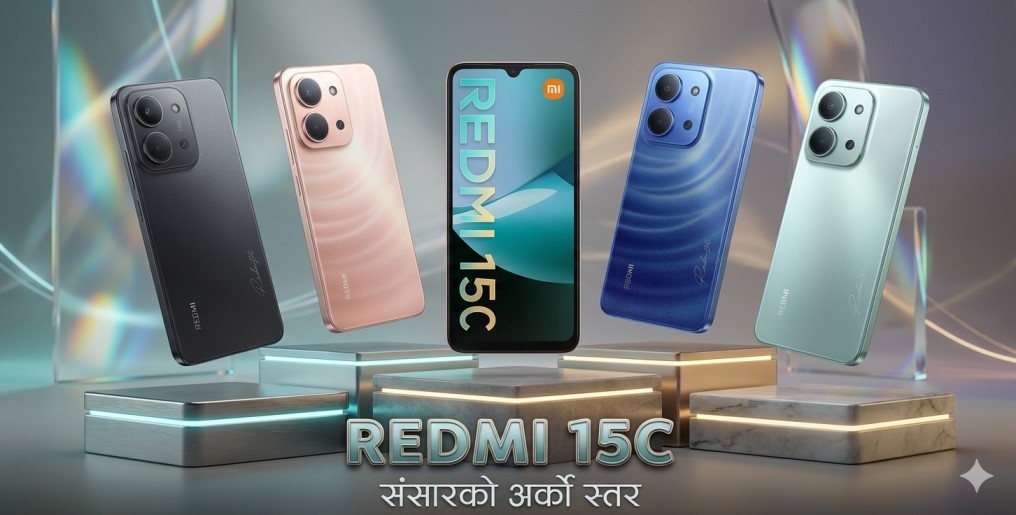
Redmi’s “C” series has long been the cornerstone of the budget smartphone market in Nepal. It is the go-to recommendation for students, first-time users, or anyone needing a reliable secondary device. With the launch of the Redmi 15C, Xiaomi is attempting to redefine the “entry-level” experience by offering features previously reserved for mid-range phones: a massive 6.9-inch display and a mammoth 6,000mAh battery.
But as the competition heats up from brands like Samsung and Vivo, does the Redmi 15C do enough to earn its spot in your pocket? Let’s dive deep into our detailed review.
Table of Contents
1. Design and Build: Premium Aesthetics on a Budget
The first thing that strikes you about the Redmi 15C is its size, followed immediately by its refined design. Xiaomi has moved away from the bulky circular camera modules of 2024, opting for a cleaner “Floating Crater” deco that looks sophisticated and modern.
- The Feel in Hand: Despite its 6.9-inch screen, the phone is surprisingly slim at just 7.99mm. However, at 205 grams, it has a reassuring heft. It’s a tall device, so one-handed use is nearly impossible for most, but the 3D quad-curved back helps it nestle comfortably into your palm.
- Durability: A standout feature is the IP64 rating. While not fully waterproof, it is resistant to dust and water splashes—a rarity at this price point. It also features Wet Touch Technology 2.0, allowing the screen to respond accurately even if your fingers are damp or oily.
- Color Options: Available in Midnight Black, Moonlight Blue, Mint Green, and Twilight Orange. The Twilight Orange variant features a textured finish that provides extra grip and successfully hides smudges.
2. Display: A Massive 120Hz Canvas
The Redmi 15C boasts the largest display ever seen in the Redmi C-series. The 6.9-inch IPS LCD panel is designed for one thing: immersion.
- Visual Experience: Watching YouTube or scrolling through TikTok feels like using a mini-tablet. The 120Hz AdaptiveSync refresh rate makes a world of difference; animations feel fluid, and UI navigation is noticeably smoother than the standard 60Hz or 90Hz screens found in competitors.
- Brightness & Comfort: With a peak brightness of 810 nits (HBM), the screen remains perfectly legible under the afternoon sun in Kathmandu. It also carries Triple TÜV Rheinland certifications, including DC dimming to reduce eye strain during late-night browsing.
- The Resolution Trade-off: To keep the price low, Xiaomi stayed with HD+ (1600 x 720) resolution. On such a large screen, the pixel density is around 254 PPI. While fine for general use, sharp-eyed users might notice a slight lack of crispness in fine text or high-resolution icons.
3. Performance: Helio G81-Ultra & HyperOS 2
Under the hood, the Redmi 15C is powered by the MediaTek Helio G81-Ultra. This is a 12nm octa-core processor optimized for efficiency and daily reliability.
- Software Experience: The phone runs on Xiaomi HyperOS 2 based on Android 15. Xiaomi promises a “48-month like-new fluency,” meaning the software is optimized to prevent the typical “lag” that budget phones develop after a year of use.
- Multitasking: With up to 8GB of LPDDR4X RAM and an additional 8GB of Virtual RAM (Memory Extension), the phone handles switching between apps like WhatsApp, Facebook, and Chrome with ease.
- Storage: You get options for 128GB or 256GB of internal storage. While it uses eMMC 5.1 (slower than UFS storage), the dedicated MicroSD slot allows for expansion up to 1TB, ensuring you never run out of space for photos and videos.
4. Gaming Benchmarks: Casual vs. Hardcore
We tested the Redmi 15C with some of the most popular titles in Nepal:
- Free Fire: Performs excellently. At Medium-High settings, the game maintains a steady frame rate, taking full advantage of the 120Hz display.
- PUBG Mobile: Playable at ‘Smooth-Ultra’ (40fps). While it handles the early game well, you might notice frame drops in crowded areas like Pochinki or during intense squad fights.
- Mobile Legends: Very smooth. The large screen provides a great advantage in terms of visibility and control placement.
Verdict: This is a fantastic device for casual gaming, but hardcore competitive players might want to look at the more expensive Redmi Note or Poco series.
Is the Nintendo Switch 2 the ultimate console of 2025? 🌟 We dive deep into the performance, display upgrades, and why this console is a game-changer for players worldwide. Don’t buy it until you read this!
Check out the deep dive: https://www.phadera.com/nintendo-switch-2-review-2025-next-gen-gaming-redefined/
5. Camera: 50MP AI Dual System
The camera setup is straightforward but effective. You get a 50MP main sensor paired with a depth-sensing auxiliary lens.
- Daylight: In bright outdoor conditions, the 50MP sensor captures vivid colors and decent detail. The HDR mode does a good job of balancing shadows and highlights.
- Low Light: The dedicated Night Mode is a lifesaver. It artificially brightens scenes and reduces noise, making nighttime street photography surprisingly usable.
- Selfies: The 8MP (or 13MP in some regions) front camera features a Soft-light ring, which uses the screen to provide a gentle fill light for better selfies in dark environments.
- Video: Maxes out at 1080p @ 30fps. Since there is no OIS or heavy EIS, videos can be a bit shaky if you’re walking, so a steady hand or a tripod is recommended.
While many brands focus on flashy designs, Sony remains the king of unmatched build quality and professional-grade interfaces. From cinematic displays to pro camera controls, see why nobody beats Sony in the smartphone game. 📱🔥
Read the full breakdown here: https://www.phadera.com/no-one-can-beat-sony-in-the-smartphone-game-unmatched-quality-and-a-pro-level-interface/
6. Battery & Charging: The Real Selling Point
The 6,000mAh battery is the undisputed star of the show.
- Real-World Endurance: For a moderate user, this is easily a 2.5-day phone. During our testing, we managed over 20 hours of continuous video playback and nearly 80 hours of music.
- Charging Speed: The upgrade to 33W Fast Charging is significant. It takes the phone from 0% to 50% in approximately 31 minutes. A full charge takes just under two hours, which is impressive given the sheer size of the battery.
- Reverse Charging: The phone supports 10W Wired Reverse Charging, allowing you to use your Redmi 15C as a power bank to charge your earbuds or a friend’s phone in an emergency.
Redmi 15C Full Specification Table
| Category | Specification Details |
| Launch | September 2025 / Official Availability 2026 |
| Price (Nepal) | Starts at Rs. 16,999 (4/128GB) up to Rs. 21,999 (8/256GB) |
| Display | 6.9″ IPS LCD, 120Hz AdaptiveSync, 810 nits (HBM) |
| Resolution | HD+ (1600 x 720), 254 PPI |
| Protection | Corning Gorilla Glass 3, IP64 Dust & Splash Resistance |
| Chipset | MediaTek Helio G81-Ultra (12nm) |
| Software | Xiaomi HyperOS 2 (Android 15) |
| RAM | 4GB / 6GB / 8GB LPDDR4X (Expandable up to 16GB) |
| Storage | 128GB / 256GB eMMC 5.1 (Up to 1TB via MicroSD) |
| Rear Camera | 50MP Main (f/1.8) + Auxiliary Lens |
| Front Camera | 8MP/13MP (Region dependent) with Soft-light ring |
| Battery | 6,000mAh Li-Po |
| Charging | 33W Fast Charging (Type-C) |
| Audio | 3.5mm Headphone Jack, 200% Volume Boost Mode |
| Sensors | Side-mounted Fingerprint, AI Face Unlock, Accelerometer |
7. Competitive Comparison: How it stacks up?
| Feature | Redmi 15C | Samsung Galaxy A06 | Vivo Y05 |
| Screen Size | 6.9″ (Winner) | 6.7″ | 6.56″ |
| Refresh Rate | 120Hz (Winner) | 60Hz | 90Hz |
| Battery | 6000mAh (Winner) | 5000mAh | 5000mAh |
| Charging | 33W (Winner) | 25W | 15W |
Final Verdict: Should You Buy the Redmi 15C?
The Redmi 15C is a specialist device. It isn’t trying to be the fastest or the best camera phone; it’s trying to be the most reliable.
The Good:
- Entertainment King: The massive 6.9-inch 120Hz screen is unmatched for content consumption at this price.
- Legendary Battery: 6000mAh ensures you never have “low battery anxiety.”
- Modern Design: IP64 rating and premium colors make it feel like a more expensive device.
- HyperOS 2: The software is clean, fast, and optimized for long-term use.
The Bad:
- Display Sharpness: HD+ resolution on a 6.9-inch screen is a bit of a stretch.
- Storage Speed: eMMC 5.1 means apps install slower than UFS-equipped phones.
- Large Footprint: It might be too big for users with small hands or small pockets.
Conclusion: If you prioritize battery life, screen size, and smooth daily performance, the Redmi 15C is currently the best value-for-money smartphone under Rs. 20,000 in Nepal. It is a solid, dependable workhorse that delivers exactly what it promises.
Redmi 15C Price Table (April 2026)
Here is the updated Global (USD/INR) and Nepal price table for the Redmi 15C as of April 2026. In the global market, there is significant buzz surrounding its 5G version, which results in some variation in pricing.
| Variant (RAM/ROM) | Price in Nepal (NPR) | Price in India (INR) | Global Price (USD) |
|---|---|---|---|
| 4GB + 128GB | Rs. 16,999 | ₹ 12,499 | $ 109 |
| 6GB + 128GB | Rs. 18,999 | ₹ 14,332 | $ 125 |
| 8GB + 256GB | Rs. 21,999 | ₹ 19,990 | $ 136 |
Looking for a powerful smartphone that won’t break the bank? 💸 The 2025 budget market is more competitive than ever! Check out the top 5 smartphones under $300 that offer the best bang for your buck.
See the list here: https://www.phadera.com/top-5-budget-smartphones-under-300-in-2025-global-edition/
Our Rating: 4.5/5 ⭐⭐⭐⭐⭐
Frequently Asked Questions (FAQ)
The Redmi 15C is available in three variants. The 4/128GB version costs Rs. 19,999, the 6/128GB costs Rs. 21,999, and the 8/256GB version is priced at Rs. 24,999.
It features a massive 6.9-inch IPS LCD display with a smooth 120Hz refresh rate, providing an immersive experience for videos and scrolling.
Yes, Xiaomi provides a 33W fast charger inside the box, which can charge the 6,000mAh battery from 0% to 50% in about 31 minutes.