
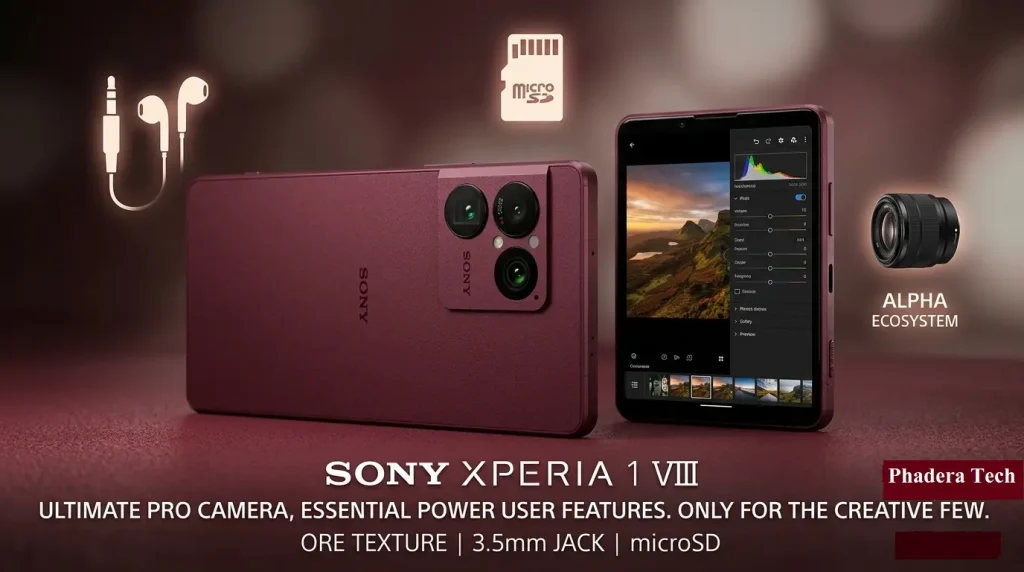
For the last few years, smartphone flagships have felt like they are running on a giant treadmill of predictability. Every year, we get a slightly shinier back glass, a processor that boasts a double-digit percentage bump in efficiency, and an artificial intelligence suite that promises to rewrite our emails or erase strangers from our vacation photos. They look identical, they feel identical, and they think identical.
Then there is Sony.
The Tokyo tech giant has long treated its mobile division not as a mass-market popularity contest, but as a specialized tool boutique for creators. While mainstream giants aggressively stripped away legacy hardware to create sealed glass sandwiches, Sony kept the headphone jack. While others forced users into cloud subscriptions, Sony left the MicroSD slot open.
With the launch of the Sony Xperia 1 VIII (internally recognized as the Xperia 1 M8), Sony is doubling down on this stubborn non-conformity. But this isn’t just another iterative refresh for the alpha-shooter cult. With a heavily reworked chassis texture, an overhauled multi-frame pipeline, and a massive physical upgrade to its telephoto glass, the 2026 Xperia flagship wants to prove it can run with the mainstream heavyweights without losing its purist soul.
Many critics argue that regular users shouldn’t look at this device, but from a hardware perspective, no one can beat Sony in the smartphone game when it comes to unmatched quality and a pro-level interface. Their commitment to dedicated features is still unparalleled.
Just bought a new smartphone? Don’t miss these essential steps out of the box! Learn how to transfer your data safely, boost battery performance, and unlock hidden features with our comprehensive guide on how to setup a new Android phone like a pro.
Let’s look beyond the spec sheet to see how the Xperia 1 VIII holds up in the messy reality of daily life. Read more about why Sony retained theheadphone jack and microSD sloton the Xperia 1 VIII.
The Design: Raw Stone, Micropatterns, and the “ORE” Texture
Pick up any modern flagship—be it from Cupertino or Suwon—and your fingers are greeted by the exact same sensation: chemically treated satin glass that feels premium but slips out of a dry palm like a wet bar of soap.
Sony chose a completely different tactile path for the Xperia 1 VIII. They call it the ORE Texture.
Smart Tactile Friction Simulator
Simulating physical friction properties: Satin Glass vs Xperia ORE Micro-Ridges.
Device Configuration
Microscopic Texture Profile
Dynamic Safety Diagnostics
Instead of a smooth finish, the rear glass features a highly engineered, microscopic industrial relief pattern. When you slide your finger across the back, it doesn't feel like glass at all; it feels like finely machined, high-grade carbon composite or a piece of raw volcanic stone. This micro-texture creates massive mechanical friction against your skin. You can hold this phone loosely at a steep angle, and it stays anchored to your hand. It is an engineering choice designed explicitly for people who want to use their phone without a case.
The physical footprint retains Sony’s signature tall-and-narrow ethos, measuring 162 x 74 x 8.3 mm and weighing an incredibly balanced 200 grams. The aluminum side rails feature deep, longitudinal ridges that serve two purposes: structural rigidity and an explicit thumb-rest when holding the phone horizontally in a traditional camera grip.
Read the comprehensive breakdown of the hardware, performance, and screen specs over on the GSMArena Sony Xperia 1 VIII Full Review.
Sony has also shuffled the aesthetic line-up this year, offering four distinct colorways:
- Graphite Black: A deep, zero-reflection industrial charcoal.
- Iolite Silver: A cool, metallic gray with a faint, shifting violet undertone.
- Garnet Red: A rich, non-glossy crimson that recalls vintage sports car interiors.
- Native Gold: A highly exclusive, warm champagne hue reserved strictly for the top-tier 1TB SIM-free variant.
Xperia 1 VIII Complete Technical Specifications
Official 2026 flagship hardware breakdown and system profile
True to its heritage, the perimeter of the device is a wonderland of functional hardware. The right rail houses the crisp volume rocker, a lightning-fast physical capacitive fingerprint scanner embedded in the power button, and the iconic, two-stage physical camera shutter button featuring a deeply knurled surface so you can find it by feel alone. Flip to the top frame, and you will find a glorious, unabashed 3.5mm headphone jack. Peer at the SIM tray, and you can still pop it open with a thumbnail to find a tray that accepts a MicroSD card up to 2TB. In an era of forced compromises, Sony remains an island of hardware freedom.
The Screen: Moving on From the 4K Shadow
For nearly a generation, Sony’s marketing machine leaned heavily on the inclusion of a native 4K mobile display. While it looked staggering on paper, the reality was a mixed bag of aggressive downscaling to save battery life and a narrow 21:9 aspect ratio that turned standard 16:9 content into a boxed-in experience.
With the Xperia 1 VIII, Sony cements its transition to a highly practical 6.5-inch LTPO OLED display sporting a standard Full HD+ (2340 x 1080 pixels) resolution at a comfortable 19.5:9 aspect ratio.
Xperia 1 VIII Ultimate Lab
Compare tactile friction levels, check real-time aspect ratio differences, and explore precise structural engineering schematics.
Tactile Friction Standard
High-precision micro-textured back glass testing for enhanced grip stability during intensive mobile usage.
Display & Engineering
Real-time aspect ratio calculations optimized for 21:9 cinematic workflows and high-density rendering.
Purists might mourn the pixel density drop from the old 4K days, but your eyes won't. At 396 PPI (pixels per inch), text is perfectly smooth, and graphic elements show zero aliasing. More importantly, moving to an LTPO panel allows the refresh rate to dynamically scale from 1Hz all the way to 120Hz depending on on-screen motion.
The real-world benefit is immediately apparent in outdoor usability. Backed by Sony’s BRAVIA engine tuning, the panel hits a measured peak brightness of 1,510 nits under harsh direct sunlight. It isn't breaking industry records on paper, but because Sony uses an exceptionally efficient anti-reflective polarizer, visibility in high-glare environments is superb. Colors remain punchy without drifting into over-saturation, and if you flip the device into "Creator Mode," the screen maps perfectly to the BT.2020 color gamut, giving video editors an exact, unadulterated preview of their footage.
Crucially, there is no notch, punch hole, or dynamic island chewing into your content. The 12-megapixel selfie camera sits comfortably inside a razor-thin, perfectly symmetrical top bezel. When you watch a movie or play a game, you get a clean, uninterrupted rectangular canvas.
Check out the critique on why Sony continues to struggle with mainstream fundamentals at Android Authority's Xperia 1 VIII Analysis.
The Triple 48MP Camera System: The 4X Telephoto Leap
The real headline of the Xperia 1 VIII lives within the redesigned, square-ish camera housing on the rear. In previous iterations, Sony’s variable telephoto lens was a marvelous piece of micro-engineering that suffered from a tiny physical sensor size. In low-light scenarios, zooming in meant introducing significant digital noise.
This year, Sony threw out the old playbook. Every single rear camera now utilizes a high-density, 48-megapixel sensor pipeline, ensuring absolute color uniformity and resolution parity across all three focal lengths.
Camera Sensor Specifications
Lens Focal Length & Sensor Comparison
Ultra-Wide
48MP Exmor RS
1/1.56" SensorMain Wide
48MP Exmor T
1/1.35" SensorTelephoto
48MP Exmor RS
1/1.56" SensorThe Breakdown of the Array:
- Main Wide (24mm): 48MP, f/1.9 aperture, utilizing a massive 1/1.35-inch Exmor T for Mobile stacked transistor sensor with Dual Pixel PDAF and Optical Image Stabilization (OIS).
- Ultra-Wide (16mm): 48MP, f/2.0 aperture, powered by a 1/1.56-inch Exmor RS sensor with full autofocus for ultra-sharp wide perspectives and macro photography.
- Periscope Telephoto (70mm to 140mm): 48MP, f/2.8 aperture, running on a 1/1.56-inch Exmor RS sensor with OIS.
The telephoto sensor is roughly four times larger than the sensor found inside the Xperia 1 VII. This is a massive shift in mobile camera philosophy. By matching the physical sensor size of the ultra-wide and approaching the size of the main shooter, the telephoto lens no longer feels like a secondary alternative.
Real-World Image Quality: True to Life vs. Hyper-Processed
If you pull an image from an iPhone 17 Pro Max or a Galaxy S26 Ultra, the immediate reaction is often "Wow." But look closer, and you notice that the sky is an impossibly deep blue, the shadows are artificially boosted by aggressive HDR algorithms, and the edges of tree leaves are sharpened to the point of looking digital.
Sony doesn't do that. The Xperia 1 VIII processes images like a Sony Alpha mirrorless camera.
Image Processing Pipeline Comparison
How mainstream brands handle images vs. Sony Xperia's philosophy
In daylight, photos look wonderfully organic. Midtones are preserved, shadows are allowed to stay dark if the scene demands it, and skin tones are rendered with unmatched accuracy. The 24mm Exmor T sensor behaves beautifully, capturing micro-contrast in fabrics and architecture that other phones wipe away through computational smoothing.
Thanks to the massive new 1/1.56-inch sensor, the 70mm telephoto lens is a portrait revelation. It produces genuine, optical bokeh—the physical separation between your subject and the background isn't a software blur trick; it’s a byproduct of real camera optics. Even when light drops at a late-night music gig, the telephoto retains rich saturation and structural detail without devolving into a muddy watercolor painting.
See the real-world usage and software evaluation from Trusted Reviews' Xperia 1 VIII Coverage.
The Software Twist: Entering the AI Era with Restraint
For years, Sony's default camera interface looked like it was lifted directly from a professional cinema rig. While manual enthusiasts loved having access to shutter speeds, ISO steps, and manual white balance dials, everyday users who just wanted a quick photo of their dinner felt completely overwhelmed.
To address this, Sony introduces the AI Camera Assistant.
Instead of hiding manual controls or using AI to swap out the sky entirely, the AI Assistant analyzes the frame and instantly generates four distinct visual suggestions on the bottom of the viewfinder.
- Suggestion 1 (Rich & Vibrant): Gently elevates primary colors for lush landscapes or colorful street scenes without clipping highlights.
- Suggestion 2 (Chic & Deep): Deepens midtone contrasts and pulls down exposure slightly—perfect for giving a rustic bakery or an industrial coffee shop an elegant, moodier feel.
- Suggestion 3 (Mellow Brightness): Softens harsh lighting, raising blacks slightly to mimic a vintage, film-like portrait look.
- Suggestion 4 (High Contrast Expression): Prioritizes sharp tonal separation, ideal for graphic architectural photography or dramatic black-and-white silhouettes.
If you like a particular suggestion, you can lock those parameters into a Custom Look profile, creating a personalized signature style that applies to every photo you take moving forward.
The computational pipeline also brings RAW Multi-Frame Processing and advanced Auto-Framing for video. If you are vlogging on a tripod, the camera will digitally crop and smooth the frame to follow you seamlessly as you move across the room, mimicking a live camera operator.
However, the software experience isn't flawless. During heavy testing sessions—specifically when firing continuous 4K 120FPS HDR video clips back-to-back—the Pro Camera interface can occasionally stutter or delay saving a burst of RAW files. Sony’s camera apps remain incredibly powerful, but they still require a bit of patience compared to the foolproof point-and-shoot nature of its rivals.
Read a detailed breakdown of the everyday display compromises at Stuff Magazine's Xperia 1 VIII Review.
Performance: Pure Snapdragon 8 Elite Horsepower
Under the hood, the Xperia 1 VIII features the pinnacle of 2026 silicon mobile architecture: the Qualcomm Snapdragon 8 Elite Gen 5 processor, built on an ultra-precise 3nm fabrication node.
The core architecture is an absolute beast:
- 2x Oryon V3 Phoenix Large Cores clocked at a blazing 4.61 GHz
- 6x Oryon V3 Phoenix Medium Cores running at 3.53 GHz
- Adreno 840 GPU
Depending on the configuration you choose, this silicon brain is paired with either 12GB or 16GB of LPDDR5X RAM and up to 1TB of blazing-fast UFS 4.1 storage.
Looking to secure your photos, files, and system backups across all your devices? Check out our complete comparison guide on the Best Cloud Backup & Storage Services in 2026 to evaluate the top options for security, pricing, and storage value.
If you want to see how Sony's raw thermal management stacks up against other cutting-edge Snapdragon 8 Elite devices, read our full Realme GT 8 Pro vs. GT 7 Pro Flagship Review.
BENCHMARK PERFORMANCE
2026 Flagship Hardware Testing
In daily use, the phone feels effortlessly quick. Apps open instantly, scrolling through heavy data feeds shows absolutely zero micro-stutter, and exporting a 4K video project inside mobile editing suites takes a fraction of the time it did on older devices.
For mobile gaming, the Adreno 840 GPU handles high-fidelity graphics with ease. Titles like Genshin Impact or modern ray-traced competitive shooters run at a locked, buttery-smooth 120 frames per second.
To prevent the tall chassis from turning into a hand-warmer under heavy loads, Sony expanded the internal cooling structure. While it doesn't feature an external fan, it utilizes an aggressive passive cooling layout that keeps thermal throttling at bay for about 25 minutes of sustained, max-tier gaming before gently dialing back performance to protect the internal components.
Audio and Media: A Haven for Audiophiles
While almost every other phone brand treats audio as a wireless afterthought, Sony continues to view the Xperia as a pocket-sized WALKMAN.
The 3.5mm headphone jack isn't just a physical port; it is backed by a high-fidelity digital-to-analog converter pipeline that drives high-impedance studio headphones with surprising clarity and zero hiss. If you prefer going wireless, the device supports an exhaustive suite of high-resolution codecs, including Bluetooth 6.0, LE Audio, aptX HD, aptX Adaptive, and aptX Lossless.
Balanced Front-Facing Dual Stereo Architecture
Top Speaker
Stage LayerBottom Speaker
Stage LayerFor those times you want to play audio out loud, Sony utilizes a pair of symmetrical, full-stage stereo speakers firing directly out of the front bezels. Because they point directly at your ears rather than firing downward out of the bottom frame, the stereo imaging is incredibly distinct.
Watching a movie feels deeply immersive; you can actually trace a sound effect moving from the left side of the screen to the right. The audio profile hits a clean -25.5 LUFS, earning a "Very Good" rating with rich lower-midrange response that prevents music from sounding thin or tinny.
Battery Life and Charging: The "Gentle" Philosophy
Powering this entire multimedia machine is a robust 5,000 mAh lithium-polymer battery. When paired with the power-sipping LTPO display and the thermal efficiency of the Snapdragon 8 Elite Gen 5 chip, the real-world endurance is spectacular.
Under an active use loop consisting of web browsing, social media scrolling, video streaming, and occasional photo capturing, the Xperia 1 VIII easily clocks past 17 hours of active screen time. For the average user, this is comfortably a two-day phone. Even for digital power users, you will find yourself heading to bed with a reassuring 30% to 40% battery cushion remaining.
"Gentle" Charging Profile Architecture
Optimized Power Delivery for Multi-Year Lifespan
Where Sony will undoubtedly divide opinions is its approach to charging speeds. In a world where competitor brands are pushing 100W or even 120W charging bricks that juice a phone from zero to full in fifteen minutes, Sony remains firmly locked to 30W wired charging (via USB Power Delivery 3.0 PPS) and 15W wireless charging.
A quick 30-minute top-up on a wired plug takes you from dead zero to roughly 50%. A full charge takes a little over an hour and twenty minutes.
Sony’s stance here is explicitly long-term. By rejecting hyper-fast charging, they prevent the battery cell from experiencing extreme thermal stress. Sony claims the battery chemistry is rated for 1,400 charge cycles before showing any significant degradation. For the consumer, this means that four or five years down the line, the phone’s battery health will remain incredibly strong, directly aligning with Sony’s software commitment of providing four major Android OS upgrades and up to six years of security patches running on Android 16.
Browse official colorways, retail options, and technical specifications directly via the Official Sony UK Xperia 1 VIII Product Page.
Specification Summary: Sony Xperia 1 VIII
To see how all these pieces fit together structurally, here is a comprehensive breakdown of the core platform specifications:
Xperia 1 VIII Complete Technical Specifications
Official 2026 flagship hardware breakdown and system profile
With Google officially teasing its upcoming hardware event, expectations are high for the next generation of AI-driven smartphones. If you're curious about the new "Pixel Glow" camera bar feature, mandatory 256GB base storage upgrade, and confirmed price hikes, read our full article onGoogle Pixel 11 Pro Leaks, Price & Specsfor an in-depth analysis.
The Verdict: Who is the Xperia 1 VIII Truly For?
The Sony Xperia 1 VIII is an absolute masterpiece of niche engineering, but it is fundamentally a polarizing device.
If you are a regular consumer looking for an effortless point-and-shoot camera that heavily retouches your selfies, automatically turns night scenes into artificial daylight, and matches the ultra-thin, smooth aesthetic of mainstream fashion trends, this phone isn't for you. At a starting price hovering around €1,499, it is an incredibly expensive investment if you plan to leave it on full automatic mode.
While the Xperia asks for ultra-premium money, you can get better software longevity and point-and-shoot reliability for less. Check out our iPhone 17 Pro Max Review: Beyond the Hype to see how Apple's vapor cooling system and A19 Pro chip handle heavy workloads without throttling.
Is the Xperia 1 VIII Right For You?
A quick look at who this phone is built for—and who should pass.
BUY IT IF:
- ✦ You shoot manual raw photo & video
- ✦ You need a MicroSD card slot & audio jack
- ✦ You love true-to-life, natural color rendering
SKIP IT IF:
- ✦ You want effortless, point-and-shoot auto mode
- ✦ You want 100W+ ultra-fast charging speeds
- ✦ You prefer aggressive, saturated AI image editing
But if you are a mobile filmmaker, an enthusiast photographer, or an Alpha camera user who wants a smartphone that behaves like a dedicated piece of optical gear, the Xperia 1 VIII has no equal. It rewards manual skill. It gives you raw, uncompressed files with breathtaking color accuracy. It preserves the invaluable physical legacy of expandability and high-fidelity wired audio.
Sony didn’t build a phone to please everyone. They built a magnificent, uncompromising creative instrument for the few who know exactly how to use it.
If you are going to spend premium flagship money but aren't sold on Sony's manual camera quirks, you might want to look into the foldable market. See our Samsung Galaxy Z Fold 8 vs. Fold 7 vs. Fold 6 Comparison to find out if extra screen real estate makes more sense for your daily workflow.
Sony Xperia 1 VIII FAQ
Is the Sony Xperia 1 VIII worth buying for everyday users?
No, the Sony Xperia 1 VIII is not recommended for regular users. While it offers a great textured "Ore Design," an uninterrupted display, a headphone jack, and microbSD storage, its ultra-premium price of €1,499, slower 30W charging, 1080p screen downgrade, and complex camera software make mainstream flagships like Samsung or Apple a much better fit for average buyers.
Why did Sony drop the continuous optical zoom on the Xperia 1 VIII?
Sony replaced the continuous moving optical zoom lens with a massive, fixed 2.9x telephoto sensor. This sensor is nearly four times larger than previous generations, allowing it to capture vastly more light and detail, prioritizing raw image quality and professional control over a longer variable zoom range.
Does the Sony Xperia 1 VIII retain the headphone jack and SD card slot?
Yes, the Sony Xperia 1 VIII proudly features a dedicated 3.5mm headphone jack for high-res audio enthusiasts and a toolless microSD card slot that supports expandable storage up to 2TB, features that almost all other modern flagship smartphones have completely abandoned.
How long does it take to fully charge the Sony Xperia 1 VIII battery?
The Sony Xperia 1 VIII packs a 5,000mAh battery but is restricted to 30W wired charging speeds. It takes approximately 83 minutes to reach a 100% full charge from empty, which is significantly slower than competitors using modern fast-charging tech.

Dal Bahadur is a passionate tech enthusiast, hardware reviewer, and the founder of Phadera Tech. With years of experience in mobile technology and digital troubleshooting, he specializes in deep-dive smartphone reviews, gadget guides, and practical tech tips. His goal is to help readers make informed decisions before buying their next gadget.